

An enterprise SEO automation platform is a software solution designed to handle large-scale search engine optimization tasks automatically, reducing manual effort across thousands or even millions of web pages. These platforms combine technical auditing, content optimization, rank tracking, and reporting into a single, unified workflow. They are built specifically for organizations where SEO complexity, content volume, and team size make manual processes impractical.
Studies show that enterprise organizations using SEO automation tools report up to 60% reduction in time spent on routine technical audits compared to manual processes. That freed-up time allows SEO teams to focus on strategy, creative content, and competitive analysis instead. The productivity gains alone often justify the platform investment within the first quarter of use.
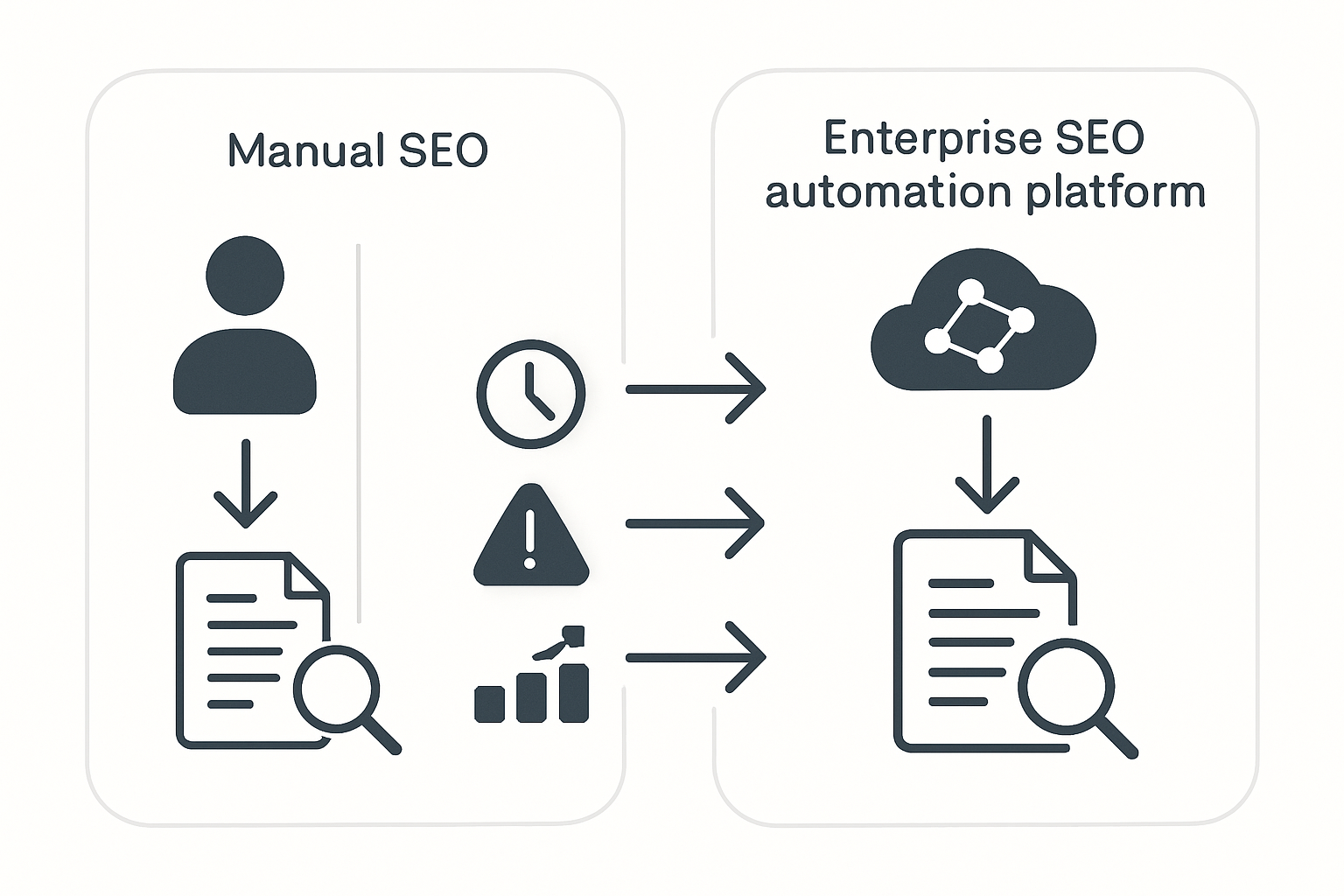
The best way to understand why automation matters at scale is to consider a retailer managing 500,000 product pages. Manually checking each page for broken links, missing metadata, or crawl errors would be impossible. An enterprise SEO automation platform continuously monitors every page, flags issues in real time, and can even push fixes automatically through CMS integrations.
What Is an Enterprise SEO Automation Platform and How Does It Differ from Standard Tools?
An enterprise SEO automation platform is defined as a cloud-based or on-premise system that automates repetitive SEO tasks at a scale and speed no human team can match manually. Standard SEO tools like browser plugins or small-business dashboards handle hundreds of pages at best. Enterprise platforms are engineered to process millions of URLs, dozens of domains, and data from thousands of keywords simultaneously.
The core difference lies in infrastructure, integrations, and governance features. Enterprise platforms connect directly to Google Search Console, Adobe Analytics, Salesforce, CMS systems, and internal data warehouses. They also include role-based access controls, approval workflows, and audit logs that satisfy the security and compliance requirements of large organizations.
Key capabilities that separate enterprise platforms from standard tools include:
- Automated technical auditing across millions of URLs on a scheduled or real-time basis
- AI-driven content recommendations mapped to search intent and competitive gaps
- Automated internal linking that dynamically adjusts as new content is published
- Cross-domain rank tracking for multiple brands, regions, and languages
- Custom reporting automation that delivers stakeholder dashboards without manual data pulls
- API access for integrating SEO data into proprietary systems and BI tools
How Does an Enterprise SEO Automation Platform Actually Work?
Enterprise SEO automation platforms work by combining web crawlers, machine learning models, and data pipelines into a continuous optimization engine. The platform crawls your site on a defined schedule, compares current performance against benchmarks, and triggers automated actions or alerts when thresholds are crossed. Think of it as a 24/7 SEO analyst that never sleeps and never misses an issue.
The workflow typically follows four stages: discover, analyze, prioritize, and act. In the discovery stage, the crawler maps every URL, link, image, and structured data element across your entire web presence. During analysis, the platform compares your technical health, content quality, and keyword performance against competitors and historical baselines.
In the prioritization stage, AI algorithms rank issues by their estimated revenue or traffic impact, ensuring your team focuses on what matters most first. The action stage is where true automation shines — the platform can push meta tag updates, generate XML sitemaps, flag duplicate content, and submit pages for reindexing automatically. According to BrightEdge research, companies that automate SEO workflows see organic traffic improvements 2x faster than those relying on purely manual processes.
Why Choose an Enterprise SEO Automation Platform Over Hiring More SEO Staff?
Enterprise SEO automation platforms deliver consistent, scalable output that even the most talented SEO team cannot replicate manually at volume. A team of ten experienced SEO specialists cannot simultaneously monitor keyword rankings across 50,000 terms, audit 2 million pages weekly, and generate personalized reports for 30 different stakeholders. The platform handles all three simultaneously, around the clock.
The cost comparison also favors automation strongly. The average salary for a senior enterprise SEO manager in the United States reached approximately $112,000 annually in 2025, not including benefits, training, or tools. A mid-tier enterprise SEO automation platform typically costs between $2,000 and $15,000 per month depending on scale, replacing the equivalent output of multiple full-time hires.
Automation also eliminates human error from repetitive tasks. Manual metadata updates across thousands of pages inevitably lead to inconsistencies, typos, and missed pages. Automated platforms apply rules uniformly and log every change, creating a reliable audit trail for future analysis and compliance reviews.
What Features Should You Look for in an Enterprise SEO Automation Platform?
The best enterprise SEO automation platforms share a core set of features that separate genuinely powerful tools from rebranded small-business software. Evaluating platforms against this checklist helps organizations avoid costly mistakes during procurement. Not every platform excels in every area, so mapping features to your specific use cases is essential.
Technical SEO automation is defined as the automated detection and resolution of crawlability, indexability, structured data, and page speed issues without requiring manual intervention for each identified problem. This feature is non-negotiable for enterprise sites. Look for platforms that support JavaScript rendering, log file analysis, and Core Web Vitals monitoring natively.
Essential features to evaluate include:
- Crawl depth and frequency controls — can you crawl millions of pages daily without throttling your server?
- AI content optimization — does the platform analyze content gaps, reading level, and entity coverage automatically?
- Automated alert systems — does it notify the right team members when rankings drop or technical errors spike?
- Localization support — can it manage hreflang tags, regional keyword sets, and local SERP tracking?
- White-label reporting — can reports be customized and automated for delivery to executives or clients?
- Third-party integrations — does it connect with Google Analytics 4, Search Console, HubSpot, or your CMS?
- Security and compliance — does it meet SOC 2, GDPR, or ISO 27001 standards your organization requires?
How Do Enterprise SEO Automation Platforms Handle AI-Driven Content Optimization?
AI-driven content optimization within enterprise SEO automation platforms works by analyzing top-ranking pages for target keywords and identifying the topics, entities, and semantic relationships your content needs to include. The platform then generates actionable recommendations that writers or editors can apply directly within their existing content workflow. Some platforms now integrate directly into CMS editors like WordPress, Contentful, or Adobe Experience Manager.
Natural language processing (NLP) is defined as a branch of artificial intelligence that enables machines to understand, interpret, and generate human language, allowing SEO platforms to evaluate content relevance, topic depth, and sentiment at scale. Modern enterprise platforms use NLP to score content against search intent automatically. This means your team receives a prioritized list of content improvements sorted by expected ranking impact before they begin writing.
The most advanced platforms now generate first-draft content briefs, meta descriptions, title tag variations, and structured data markup automatically. This reduces the time from keyword research to published, optimized content by an estimated 40 to 70 percent according to platform case studies from vendors like Conductor and Semrush Enterprise. Human editors still review and finalize all content, but the manual groundwork is handled by the platform.
What Are the Leading Enterprise SEO Automation Platforms Available Today?
Several platforms have established themselves as leaders in the enterprise SEO automation space, each with distinct strengths depending on organization size, technical stack, and budget. Choosing the right platform depends heavily on your specific use case, existing technology ecosystem, and internal SEO maturity. Evaluating platforms through a free trial or proof-of-concept engagement is the most reliable way to assess fit.
The leading options in the current market include:
- BrightEdge — strongest for AI-driven content performance measurement and revenue attribution
- Conductor — excellent for content-first enterprise teams with deep CMS integrations
- Semrush Enterprise — broad feature set covering technical SEO, content, and competitive intelligence
- Botify — specialized in technical SEO automation, JavaScript rendering, and log file analysis at extreme scale
- Oncrawl — data science-oriented platform preferred by technical SEO engineers and developers
- Lumar (formerly DeepCrawl) — enterprise crawling and governance platform with strong compliance features
Each platform offers different pricing tiers, crawl limits, and integration ecosystems. Request detailed proposals from at least three vendors before making a final purchasing decision. Always validate contract terms around data ownership, export rights, and uptime SLAs before signing.
How Do You Successfully Implement an Enterprise SEO Automation Platform?
Successful implementation of an enterprise SEO automation platform requires a structured rollout plan, cross-functional stakeholder alignment, and clear success metrics defined before go-live. Rushing implementation without proper configuration often leads to false alerts, missed integrations, and low adoption rates among SEO and content teams. Treat the platform launch as an organizational change management project, not just a software installation.
A proven implementation approach follows these six steps:
- Audit your current SEO stack — identify redundant tools, data gaps, and integration requirements
- Define success KPIs — agree on metrics like crawl coverage, issue resolution time, and organic traffic growth
- Configure crawl settings — set crawl frequency, URL exclusions, and authentication for secure sections
- Integrate data sources — connect Google Search Console, GA4, your CMS, and any internal analytics systems
- Train all users — provide role-specific training for SEO managers, content editors, and developers
- Establish automated reporting cadence — schedule weekly, monthly, and quarterly reports for all stakeholder groups
Expect a 60 to 90 day ramp-up period before the platform delivers its full value. During this period, your team learns the interface, refines alert thresholds, and validates that automated recommendations align with your brand and editorial standards. Patience during onboarding pays significant long-term dividends.
Why Is Generative AI Changing the Enterprise SEO Automation Landscape?
Generative AI is reshaping enterprise SEO automation platforms by enabling platforms to move beyond detection and recommendation into actual content creation, structured data generation, and predictive ranking modeling. Platforms are now incorporating large language models (LLMs) to generate optimized title tags, FAQ schemas, and content outlines at scale. This represents a fundamental shift from reactive SEO tooling to proactive, AI-led optimization.
The rise of AI-powered search experiences from Google, Bing, and emerging AI search engines has also changed what enterprise SEO platforms must measure and optimize for. Generative Engine Optimization (GEO) is defined as the practice of optimizing content so that AI-powered search engines and large language models cite, reference, or summarize your content in their generated responses. Enterprise platforms are now adding GEO scoring, featured snippet optimization, and People Also Ask monitoring as standard features.
Organizations that adopt enterprise SEO automation platforms with native generative AI capabilities are positioning themselves ahead of competitors still relying on manual workflows. The platforms that combine traditional technical SEO automation with GEO and AI content capabilities will define the category for the next decade. Choosing a platform with a strong AI development roadmap is now as important as evaluating current features.
Frequently Asked Questions
What is the average cost of an enterprise SEO automation platform?
Enterprise SEO automation platforms typically cost between $2,000 and $15,000 per month, depending on the number of URLs crawled, keywords tracked, users, and integrations required. Custom enterprise contracts for very large organizations can exceed $20,000 per month.
How long does it take to see results from an enterprise SEO automation platform?
Most organizations begin seeing measurable improvements in technical SEO health within 30 to 60 days of implementation, while organic traffic and ranking gains typically become visible within 3 to 6 months depending on site size and competitive landscape.
Can an enterprise SEO automation platform replace my SEO team?
No, enterprise SEO automation platforms are designed to amplify your existing SEO team’s capacity, not replace human expertise. The platform handles repetitive, high-volume tasks while your team focuses on strategy, creative direction, and stakeholder communication.
Which enterprise SEO automation platform is best for e-commerce sites with millions of product pages?
Botify and Semrush Enterprise are particularly strong choices for large e-commerce sites because of their advanced JavaScript rendering capabilities, faceted navigation management, and scalable crawl infrastructure designed for millions of URLs.
How do enterprise SEO automation platforms support multilingual and international SEO?
Leading enterprise platforms support international SEO through automated hreflang tag management, regional keyword tracking, country-specific crawl configurations, and localized SERP monitoring across dozens of markets and languages simultaneously.
Conclusion: Invest in Automation to Win at Enterprise SEO
An enterprise SEO automation platform is no longer optional for large organizations competing for organic visibility at scale. The combination of AI-driven insights, automated technical monitoring, content optimization, and generative AI capabilities makes these platforms the single highest-leverage investment an enterprise SEO team can make. The organizations winning in organic search today are the ones who automated routine SEO work years ago and reinvested that time into strategy.
The right platform transforms your SEO program from a reactive, issue-chasing operation into a proactive, data-driven growth engine that compounds in value over time. Every dollar saved on manual tasks is a dollar reinvested in content, links, and strategic initiatives that drive long-term competitive advantage. The scale of improvement simply cannot be achieved through headcount alone.
Ready to evaluate an enterprise SEO automation platform for your organization? Start by auditing your current SEO workflow, identifying your most time-consuming manual tasks, and requesting demos from at least three leading vendors. The right platform will pay for itself many times over — the only question is how soon you are ready to let automation do the heavy lifting.