
Enterprise SEO automation tools are software platforms designed to handle large-scale search optimization tasks — from crawling thousands of pages to generating keyword strategies across multiple business units — without requiring manual effort at every step. Growing companies face a unique challenge: they need the output of a large SEO team but often lack the budget or headcount to support one. Automation bridges that gap by replacing repetitive, time-consuming tasks with intelligent, rules-based workflows that run in the background while your team focuses on strategy.
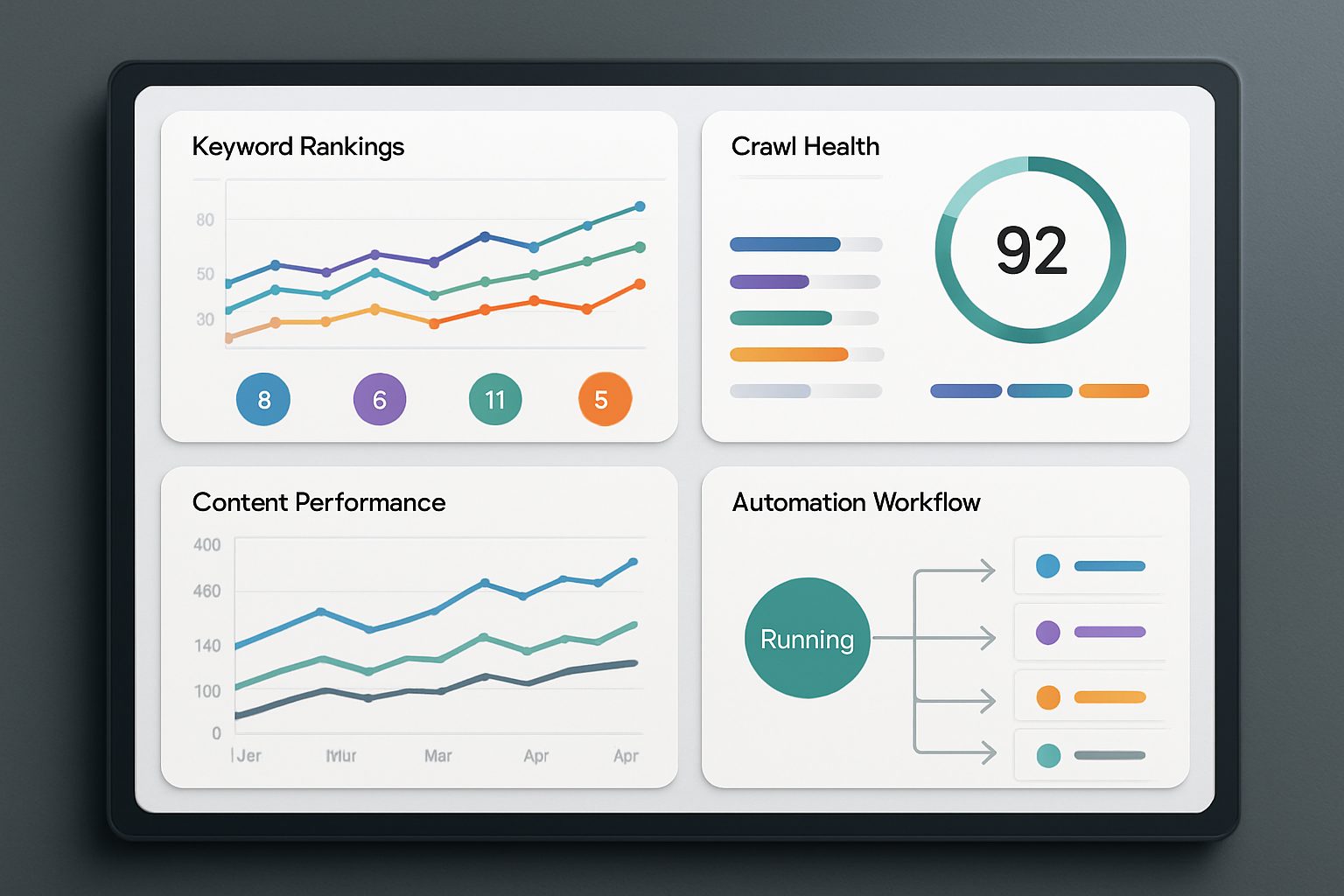
The demand for enterprise SEO automation is accelerating. According to a 2026 industry report, companies that adopted SEO automation tools saw an average 63% reduction in time spent on routine optimization tasks. That time savings translates directly into faster content deployment, quicker technical fixes, and more consistent performance monitoring. For a growing company competing against established players, speed and consistency are two of the most powerful advantages you can build.
This article breaks down exactly what enterprise SEO automation tools do, which features matter most for scaling companies, and how to choose the right platform for your growth stage. Whether you’re managing a single high-traffic website or expanding into multiple markets, the right automation stack can be the difference between plateauing and compounding your organic growth month over month.
What Is Enterprise SEO Automation and Why Does It Matter for Growing Companies?
Enterprise SEO automation is defined as the use of software systems to automatically execute, monitor, and optimize search engine optimization tasks at scale — without requiring manual input for each individual action. This includes automated crawling, rank tracking, content auditing, internal linking suggestions, schema markup generation, and reporting. The “enterprise” label reflects both the scale of operations and the sophistication of the technology involved.
For growing companies, the stakes are particularly high. A 2025 BrightEdge data study found that organic search drives 53% of all trackable web traffic across industries. Missing out on that channel — or managing it inefficiently — costs real revenue. Automation ensures your SEO program keeps pace with your business growth even when your team size hasn’t caught up yet.
Traditional SEO tools were built for smaller sites and slower workflows. Legacy platforms often require analysts to manually pull reports, export data, cross-reference spreadsheets, and then manually implement fixes. Enterprise automation tools replace that chain of manual steps with connected, intelligent systems that act on data in near real-time.
What Features Should You Look for in Enterprise SEO Automation Tools?
The best enterprise SEO automation platforms share a core set of capabilities that separate them from basic SEO software. Understanding these features helps you evaluate tools based on your actual operational needs rather than marketing claims. Below are the most critical features to prioritize.
Automated Technical SEO Auditing
Technical SEO auditing is defined as the systematic process of identifying and flagging issues on a website that prevent search engines from properly crawling, indexing, or ranking its pages. Automation makes this continuous rather than periodic — your platform monitors crawl health 24/7 and alerts your team the moment issues appear. This is especially critical for growing companies adding new pages, products, or blog content at high volume.
Automated audits should cover page speed scores, broken links, duplicate content detection, Core Web Vitals data, structured data errors, and XML sitemap health. The best platforms don’t just flag issues — they prioritize them by SEO impact so your team knows exactly where to focus first. Some advanced tools even generate fix recommendations automatically, cutting resolution time dramatically.
Keyword Research and Rank Tracking at Scale
Growing companies can’t afford to track just a handful of keywords. Enterprise SEO automation tools typically support tracking thousands of keywords across multiple locations, devices, search engines, and languages simultaneously. This is essential for companies expanding into new markets or managing product lines that each require their own keyword ecosystems.
Automated rank tracking means your team always has current data without manually running checks. Platforms with machine learning built in can also surface keyword opportunities you haven’t targeted yet, based on gaps between your content and what your competitors are already ranking for. That proactive intelligence gives growing companies a strategic edge that reactive, manual workflows simply cannot match.
Content Optimization and Gap Analysis
Content optimization automation helps writers and strategists produce pages that are aligned with search intent before publishing. The platform analyzes top-ranking pages for a given keyword, identifies the topics, questions, and entities those pages cover, and then provides a structured brief or score for your content to match or exceed. This removes guesswork and significantly improves the odds of ranking on the first page.
If you want to go deeper on this topic, the article on how to scale SEO content production with artificial intelligence explains exactly how AI-powered workflows are transforming content output for fast-growing teams. Combining content automation with technical automation creates a flywheel effect: more optimized content gets published faster, which generates more data, which further refines your automation rules.
Automated Reporting and SEO Analytics Dashboards
Manual reporting is one of the biggest time drains in any SEO program. Enterprise SEO automation tools solve this by generating scheduled reports automatically and delivering them to stakeholders in a digestible format. Instead of an analyst spending hours building a slide deck, the platform produces a live dashboard or PDF report with the metrics that matter most.
For a thorough breakdown of how to build and interpret these reports effectively, the guide on SEO performance analytics dashboards and how to track, interpret, and act on your search data is an excellent resource. Automated dashboards also support better stakeholder communication — decision-makers can see SEO progress in real time without waiting for a monthly update.

How Does SEO Automation Actually Save Time for Growing Teams?
Studies show that SEO professionals spend an average of 40% of their working hours on tasks that could be fully or partially automated. That includes crawl analysis, rank checks, report generation, internal link audits, and metadata reviews. Reclaiming that time doesn’t mean reducing headcount — it means redirecting your existing team toward higher-value activities like strategy, content creation, and CRO (conversion rate optimization).
Here’s a concrete breakdown of how automation reshapes a typical SEO workflow:
- Crawl scheduling runs automatically on a cadence your team sets — weekly, daily, or after every major site update.
- Technical issues are prioritized by impact so developers receive a clear, ranked task list without any analyst intervention.
- Keyword rankings update continuously and trigger alerts when significant movement — positive or negative — occurs.
- Content briefs are generated automatically based on the latest SERP data for each target keyword.
- Reports are distributed to stakeholders on a schedule, with no manual compilation required.
- Internal linking suggestions surface automatically as new pages are published, reducing orphaned content and strengthening topical authority.
This kind of systematic efficiency is what allows a team of five to operate with the output typically associated with a team of fifteen. For growing companies where budget efficiency is essential, that multiplication of effort is often the strongest argument for investing in enterprise SEO automation tools early in the growth curve.
Why Should Growing Companies Invest in Enterprise-Grade SEO Tools Instead of Basic Software?
Basic SEO tools are built for websites with relatively simple architectures, small keyword sets, and infrequent content publishing. Growing companies quickly outgrow these tools — not because they’re bad products, but because the complexity of managing an expanding digital presence at speed exceeds what entry-level platforms are designed to handle. The gap between a basic tool and an enterprise platform is not about features alone; it’s about scale, reliability, and automation depth.
Consider what happens when a company scales from 500 pages to 5,000 pages. Manual audits that once took hours now take days. Rank tracking across expanded product lines becomes unwieldy. Content teams struggle to maintain quality and consistency without systematic briefs and editorial workflows. Enterprise SEO automation tools handle all of this without requiring a proportional increase in team size or operational effort.
Another critical consideration is data integration. Enterprise platforms typically connect directly with Google Search Console, Google Analytics, CRM platforms, and content management systems. This means your SEO data doesn’t live in a silo — it flows into the broader business intelligence stack and informs decisions across marketing, product, and sales. That level of integration is simply not available in most basic or mid-tier tools.
How Do You Choose the Right Enterprise SEO Automation Tool for Your Company?
Choosing the right platform starts with an honest assessment of your current operational gaps. Ask your team where they’re spending the most time on manual tasks, and where data visibility is weakest. Those pain points are your primary evaluation criteria. A platform that solves your biggest bottlenecks will deliver ROI far faster than one loaded with features you won’t use for months.
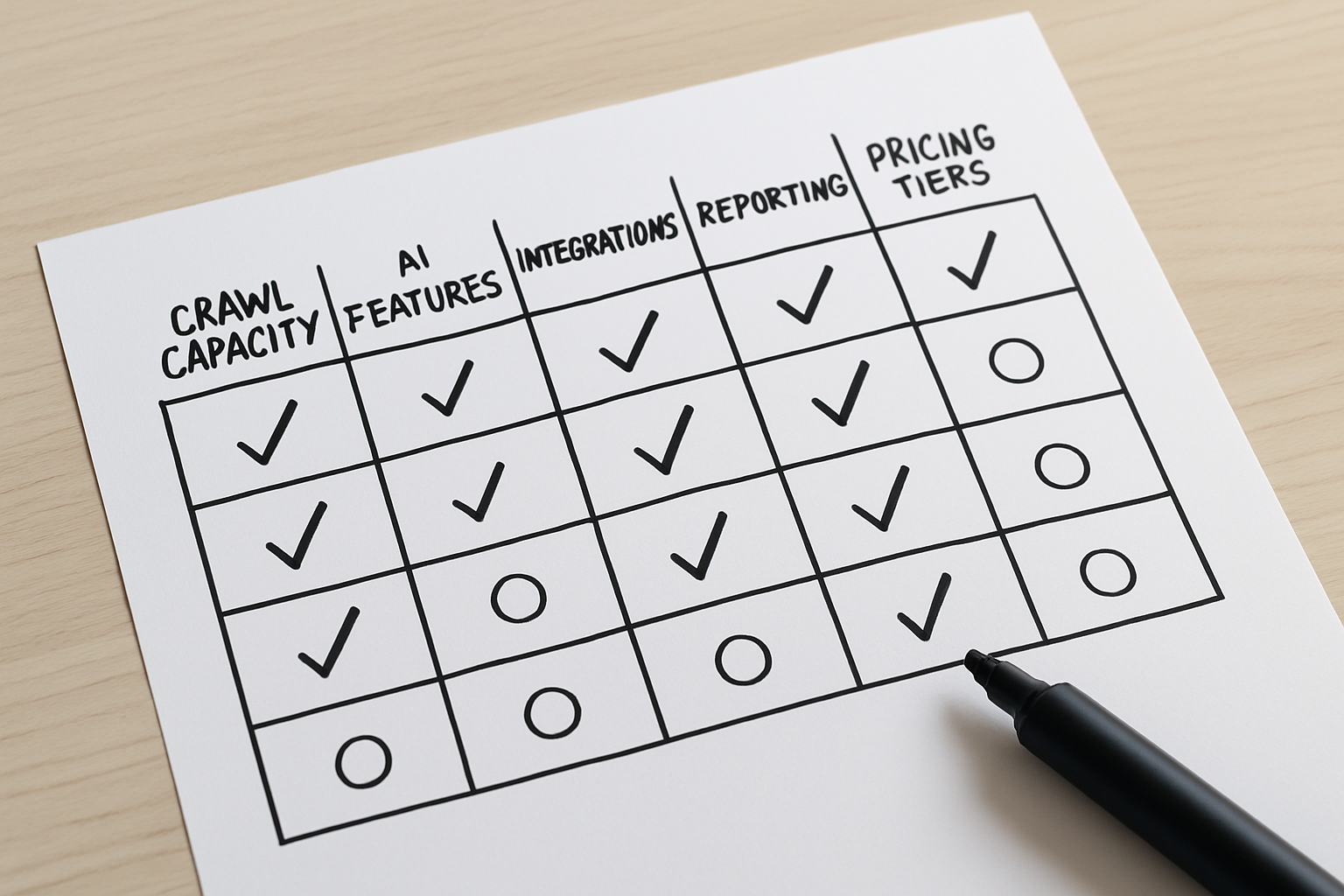
Here are the key evaluation criteria to apply when comparing enterprise SEO automation tools:
- Crawl capacity: How many pages can the platform crawl per audit, and how frequently?
- Keyword tracking volume: Does it support the number of keywords and markets you currently need, plus room to grow?
- Automation depth: Are workflows truly automated, or does the platform still require significant manual intervention?
- Reporting flexibility: Can you customize dashboards and scheduled reports for different stakeholder groups?
- Integrations: Does it connect with your existing CMS, analytics platform, and data warehouse?
- AI capabilities: Does the platform use machine learning to surface insights and opportunities proactively?
- Support and onboarding: Does the vendor provide dedicated onboarding support, especially during initial implementation?
It’s also worth reading how other growing businesses and agencies are making this decision. The article on how to choose the right AI SEO platform for your agency provides a rigorous framework that applies equally well to in-house marketing teams at growing companies. Many of the evaluation criteria overlap, particularly around scalability, workflow automation, and AI integration.
What Are the Most Impactful Use Cases for Enterprise SEO Automation?
Enterprise SEO automation tools deliver the highest impact in specific use cases that most growing companies encounter. Understanding these use cases helps you prioritize implementation and set realistic expectations for results. Below are the scenarios where automation consistently proves its value.
Large-Scale Content Auditing
Content auditing is defined as the process of evaluating every piece of published content on a website to determine its current performance, SEO value, and strategic alignment. Manually auditing thousands of pages is impractical — automation makes it routine. Platforms can flag thin content, identify cannibalization issues, surface underperforming pages with traffic potential, and recommend consolidation or refresh opportunities automatically.
For growing companies publishing content at volume, regular automated audits prevent the common problem of content debt — a growing library of pages that dilutes topical authority and confuses search engines. Automated auditing keeps your content portfolio lean, strategic, and consistently optimized without requiring a dedicated analyst for each review cycle.
Automated Internal Linking
Internal linking is one of the most consistently underutilized SEO tactics among growing companies — not because teams don’t understand its value, but because manually identifying and implementing link opportunities across thousands of pages is too time-intensive. Enterprise SEO automation tools solve this by continuously analyzing your content graph and surfacing relevant internal link opportunities as new pages are published.
Stronger internal linking improves crawl efficiency, distributes page authority more evenly across your site, and supports users in navigating to high-value conversion pages. Automating this process means every new piece of content immediately becomes part of a connected, strategically linked site architecture rather than an isolated page that search engines may undervalue.
Multi-Location and Multi-Language SEO Management
Growing companies expanding into new geographic markets face exponential complexity in their SEO programs. Managing hreflang tags, localized keyword strategies, and region-specific technical configurations manually at scale is a recipe for errors. Enterprise automation platforms centralize this management, apply rules consistently across all markets, and alert teams to international SEO issues before they impact rankings.
According to a 2026 survey of digital marketing leaders, 71% of companies managing multi-market SEO programs cited automation as “essential” or “critical” to maintaining quality and consistency across regions. That data point reflects how deeply operational complexity grows with geographic expansion — and why automation is not a luxury at that stage, but a necessity.
How Can Growing Companies Get Started with SEO Automation Without Overwhelming Their Teams?
The best way to introduce enterprise SEO automation tools is to start with the highest-impact, lowest-complexity automation first. Don’t try to automate everything at once — that approach creates confusion, erodes team confidence, and often results in automation being switched off in favor of familiar manual processes. Start with automated rank tracking and technical auditing, prove the value internally, then expand.
A practical onboarding sequence looks like this:
- Week 1-2: Set up automated crawling and configure technical audit alerts for your highest-priority pages.
- Week 3-4: Configure keyword tracking for your core keyword set and set up automated reporting for your primary dashboard.
- Month 2: Introduce content gap analysis and automated brief generation for your editorial team.
- Month 3: Enable internal linking automation and begin using AI-generated optimization recommendations.
- Month 4+: Expand to multi-location tracking, advanced segmentation, and custom workflow automation as your team becomes comfortable with the platform.
If your primary concern is content production specifically, the detailed guide on how an automated SEO platform for marketers can help you scale organic growth without the manual work is a practical companion resource. Phased implementation reduces overwhelm and builds the internal buy-in necessary for long-term adoption.
Frequently Asked Questions
What makes an SEO tool "enterprise-grade" compared to standard SEO software?
Enterprise-grade SEO tools are built to handle significantly larger scale — including thousands of pages, multiple domains, large keyword sets, and complex reporting needs — with deeper automation, stronger integrations, and more sophisticated AI capabilities than standard platforms offer.
How much time can enterprise SEO automation tools realistically save?
Industry data shows that companies using SEO automation reduce time spent on routine tasks by an average of 40% to 63%, depending on the platform and the degree of automation implemented across their workflows.
Are enterprise SEO automation tools only suitable for large corporations?
No — growing companies at the mid-market stage benefit significantly from enterprise SEO automation tools because they allow smaller teams to operate at a scale and speed that would otherwise require much larger headcount and budget.
How long does it typically take to see results from enterprise SEO automation?
Most companies begin seeing measurable efficiency gains within the first 30 days of implementation, while organic traffic and ranking improvements typically become visible within 3 to 6 months as automated optimizations accumulate and compound.
Can enterprise SEO automation tools replace human SEO strategists?
No — enterprise SEO automation tools are designed to eliminate repetitive manual tasks and surface data-driven insights, but strategic decision-making, creative content development, and stakeholder communication still require experienced human professionals.
What is the biggest mistake companies make when adopting enterprise SEO automation tools?
The most common mistake is trying to automate too many processes simultaneously during onboarding, which overwhelms teams and reduces adoption. A phased implementation starting with high-impact, low-complexity automations delivers much better long-term results.
Do enterprise SEO automation tools work for e-commerce sites with thousands of product pages?
Yes — e-commerce sites are among the biggest beneficiaries of enterprise SEO automation, particularly for automated technical auditing, faceted navigation management, product page optimization at scale, and automated schema markup for structured data.
Start Scaling Your SEO Program the Smart Way
Enterprise SEO automation tools are no longer reserved for Fortune 500 companies with eight-figure marketing budgets. Today, growing companies at every stage of scale can access powerful, AI-driven automation platforms that compress the time and effort required to build a dominant organic search presence. The companies that invest in automation early are the ones that compound their SEO advantages fastest — while competitors are still manually pulling spreadsheets and waiting for monthly reports.
The strategic advantage is clear: more data, processed faster, with less manual effort, producing more consistent results across your entire digital presence. Whether you’re managing a high-volume content program, expanding into new markets, or simply trying to get more from your existing SEO team, automation is the lever that changes the equation. Every hour recovered from manual work is an hour your team can reinvest in strategy, creativity, and growth.
RankBloom SEO is built specifically for growing companies that need enterprise-grade SEO automation without the complexity or cost of legacy platforms. From automated technical auditing and AI-powered content optimization to live performance dashboards and intelligent rank tracking, RankBloom SEO delivers the tools your team needs to scale organic growth systematically. If you’re ready to stop managing SEO manually and start building a scalable, automated search program, explore what RankBloom SEO can do for your business today and discover why modern growth-focused teams are choosing smarter automation over outdated workflows.