
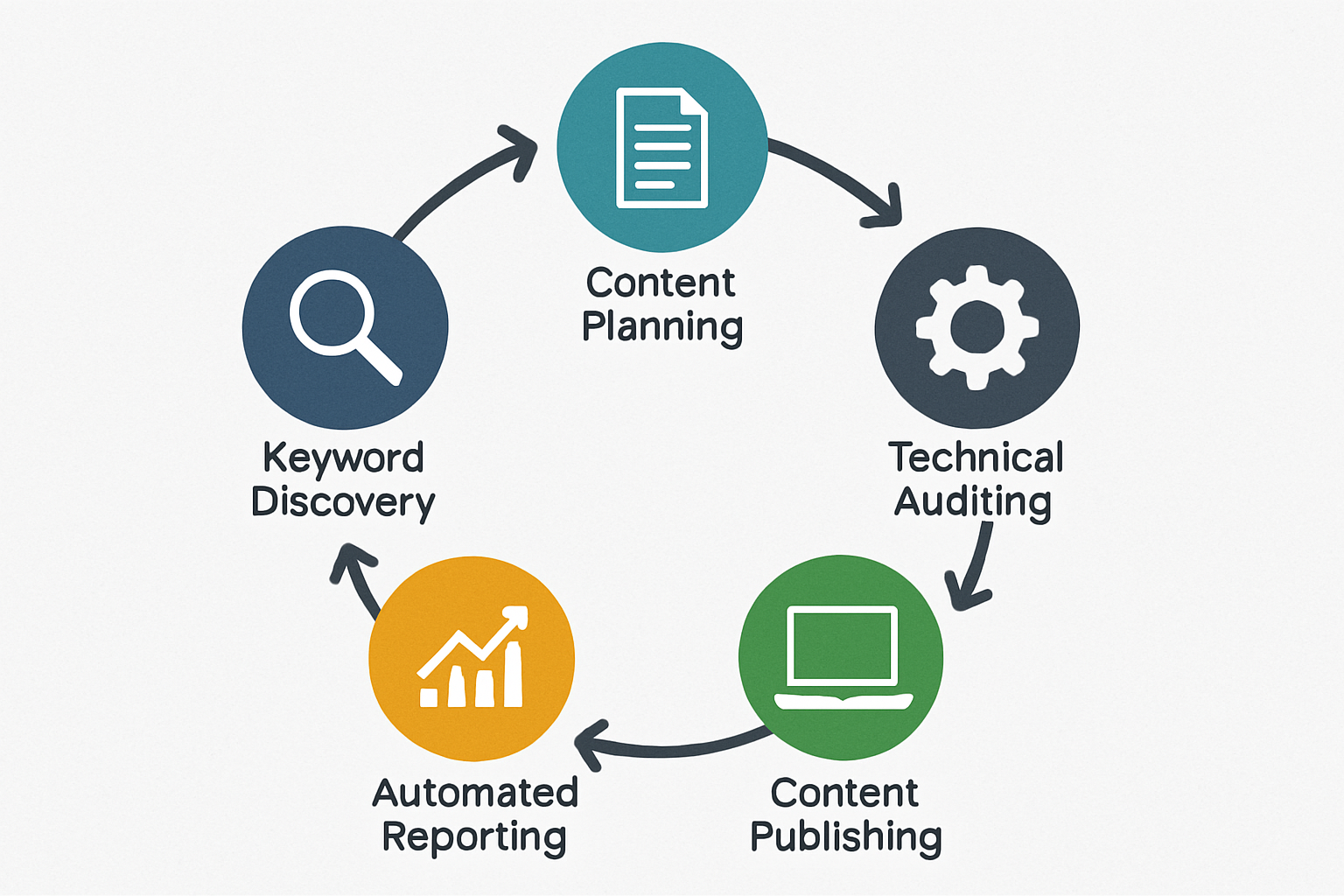
An enterprise SEO automation platform SaaS is a cloud-based software solution designed to help large organizations manage, automate, and scale their search engine optimization workflows without relying on manual processes. These platforms bring together keyword research, technical audits, content optimization, rank tracking, and reporting into a single, unified system. For enterprises managing hundreds or thousands of web pages, this level of automation is not a luxury — it is an operational necessity.

Enterprise SEO is defined as the practice of optimizing large-scale websites — typically those with thousands of pages, multiple subdomains, or international presence — using coordinated strategies and tooling built for complexity. Unlike SMB-level SEO, enterprise-level work involves cross-departmental collaboration, strict compliance considerations, and high-volume content pipelines. A dedicated SaaS platform makes coordinating all of these moving parts significantly more manageable.
Studies show that companies using automated SEO platforms reduce time spent on manual reporting by up to 60%, freeing strategists to focus on higher-value work. As search algorithms evolve rapidly in 2026, the gap between enterprises using automated SEO systems and those relying on legacy tools continues to widen. Understanding what these platforms offer — and how to choose the right one — is critical for any organization serious about organic growth.
What Is an Enterprise SEO Automation Platform SaaS?
An enterprise SEO automation platform SaaS is defined as a subscription-based, cloud-hosted software system that automates recurring SEO tasks at scale, including crawling, auditing, content scoring, and performance reporting. The SaaS delivery model means teams access the platform through a browser, with no installation required and updates deployed automatically. This makes enterprise adoption faster and infrastructure costs significantly lower compared to on-premise alternatives.
These platforms are purpose-built for organizations with complex needs: multinational sites, large content teams, multiple stakeholders, and strict governance requirements. They typically integrate with existing tech stacks such as CMS platforms, analytics tools, and data warehouses. This interoperability is a key differentiator between true enterprise platforms and scaled-up small business tools.
The automation layer is what sets these solutions apart from traditional SEO tools. Instead of manually running a crawl each week or pulling keyword data into spreadsheets, enterprise platforms schedule, execute, and surface insights automatically. Teams receive proactive alerts when technical issues arise or when ranking positions shift significantly.
Why Do Large Organizations Need SEO Automation?
Scale is the primary driver behind the need for SEO automation at the enterprise level. A mid-sized e-commerce site might have 5,000 product pages; a global retailer could have 500,000. Manually auditing, optimizing, and tracking that volume of content is simply not feasible with spreadsheets or point solutions.
Enterprise teams also face coordination challenges that smaller organizations do not. SEO decisions must align with development sprints, content calendars, legal reviews, and regional marketing strategies simultaneously. An enterprise SEO automation platform SaaS provides a central source of truth that keeps all departments aligned without constant back-and-forth communication.
Research indicates that 73% of enterprise marketers cite “inability to act on SEO data quickly” as a top barrier to organic growth. Automation directly addresses this bottleneck by reducing the lag between identifying an issue and implementing a fix. When your platform flags a crawl error automatically and routes it to the right developer, resolution time drops from weeks to days.
What Core Features Should an Enterprise SEO Automation Platform Include?
Automated Technical Auditing
Technical SEO auditing is the process of systematically crawling a website to identify issues that prevent search engines from indexing and ranking pages effectively. At the enterprise level, this must happen continuously rather than periodically. A strong platform schedules automated crawls, compares results against baselines, and flags regressions before they impact rankings.
Key technical audit features to look for include duplicate content detection, crawl budget analysis, Core Web Vitals monitoring, and structured data validation. Each of these areas can directly influence how search engines interpret and rank your pages. Automated alerts for critical issues — like a noindex tag applied to an entire section — can prevent major traffic losses.
Intelligent Keyword Research and Clustering
Keyword clustering is defined as the practice of grouping semantically related keywords together so that a single page can target multiple relevant queries simultaneously. Enterprise platforms automate this clustering process using natural language processing, saving analysts dozens of hours each month. The result is a more strategic content architecture that mirrors how modern search engines understand topics.
Beyond clustering, enterprise platforms provide keyword prioritization scoring based on difficulty, search volume, business relevance, and current ranking position. This scoring helps content teams make data-driven decisions about which topics to tackle first. For organizations producing hundreds of pieces of content monthly, this kind of intelligent prioritization is essential.
Automated Reporting and Custom Dashboards
Reporting is one of the most time-consuming aspects of enterprise SEO, particularly when multiple stakeholders need different views of the same data. Automation transforms reporting from a weekly manual task into a real-time, self-updating system. Executive dashboards, department-level reports, and technical summaries can all be generated and distributed automatically.
For a deeper look at how SEO analytics dashboards can transform your reporting workflows, explore this guide on SEO analytics dashboard software and how to track and grow your organic traffic. Custom dashboards also allow teams to define the KPIs that matter most to their specific business objectives. Revenue attribution, organic share of voice, and crawl health trends are all examples of enterprise-specific metrics that good platforms surface clearly.
Content Optimization at Scale
Content optimization at the enterprise level means ensuring thousands of existing pages remain competitive while new pages meet SEO standards before they ever go live. Automated content scoring tools analyze pages against target keywords, readability benchmarks, and competitive benchmarks in real time. Writers and editors receive actionable recommendations without needing deep SEO expertise themselves.
If you want to understand how automated content workflows can increase publishing velocity while maintaining quality, this resource on automated SEO content creation tools and how to produce optimized content at scale provides excellent practical guidance. Enterprise platforms often integrate content optimization directly into CMS workflows, so recommendations appear while content is being created. This eliminates the friction of context-switching between tools.
How Does an Enterprise SEO Automation Platform Improve Team Efficiency?
The best way to measure efficiency gains from SEO automation is to compare the hours spent on recurring tasks before and after platform adoption. Most enterprise teams report saving between 15 and 25 hours per analyst per week after implementing a comprehensive automation platform. Those hours are redirected toward strategy, creative work, and stakeholder engagement.
Workflow automation also reduces human error — a significant risk when dealing with large datasets and complex site structures. Automated validation checks catch misconfigured redirects, broken canonical tags, or missing metadata before they reach production. This proactive quality control is something that no manual process can replicate reliably at scale.
Cross-team collaboration improves as well. When developers, content strategists, and marketing managers all work from the same platform with role-appropriate views, miscommunication decreases dramatically. Integrated task management features within enterprise SEO platforms allow issues to be assigned, tracked, and resolved within a single environment.
What Should You Look for When Evaluating Enterprise SEO SaaS Platforms?
Scalability and Crawl Capacity
Not all platforms can handle enterprise-scale crawling. A platform that struggles beyond 100,000 pages will become a bottleneck rather than an asset for large organizations. Confirm that any platform you evaluate offers unlimited or high-volume crawl capacity, configurable crawl scheduling, and JavaScript rendering support. These capabilities ensure the platform grows with your site rather than constraining it.
Integration Ecosystem
Enterprise teams rarely operate with a single tool. Your SEO platform must connect cleanly with your CMS, CDN, analytics stack, data warehouse, and project management tools. Native integrations reduce data silos and eliminate the need for manual exports. API access is also essential for organizations that build custom reporting pipelines or want to push SEO data into existing business intelligence systems.
Security, Compliance, and Access Controls
Enterprise organizations operate under strict data governance requirements that consumer-grade tools were never designed to meet. Look for platforms that offer single sign-on (SSO), role-based access controls, audit logs, and SOC 2 Type II compliance. Data residency options may also be required for organizations operating in regions with strict privacy regulations such as GDPR. These are non-negotiable features for regulated industries.
AI and Predictive Intelligence
Modern enterprise SEO automation platforms increasingly incorporate artificial intelligence to move beyond reactive reporting into predictive insights. AI-powered features might include traffic forecasting, algorithm change impact predictions, and automated opportunity identification. To understand how AI is transforming enterprise SEO capabilities more broadly, this article on how AI-powered SEO platforms are changing the way businesses rank online provides important context. Platforms that leverage machine learning improve continuously as they process more of your historical data.
How Does Enterprise SEO Automation Deliver Measurable ROI?
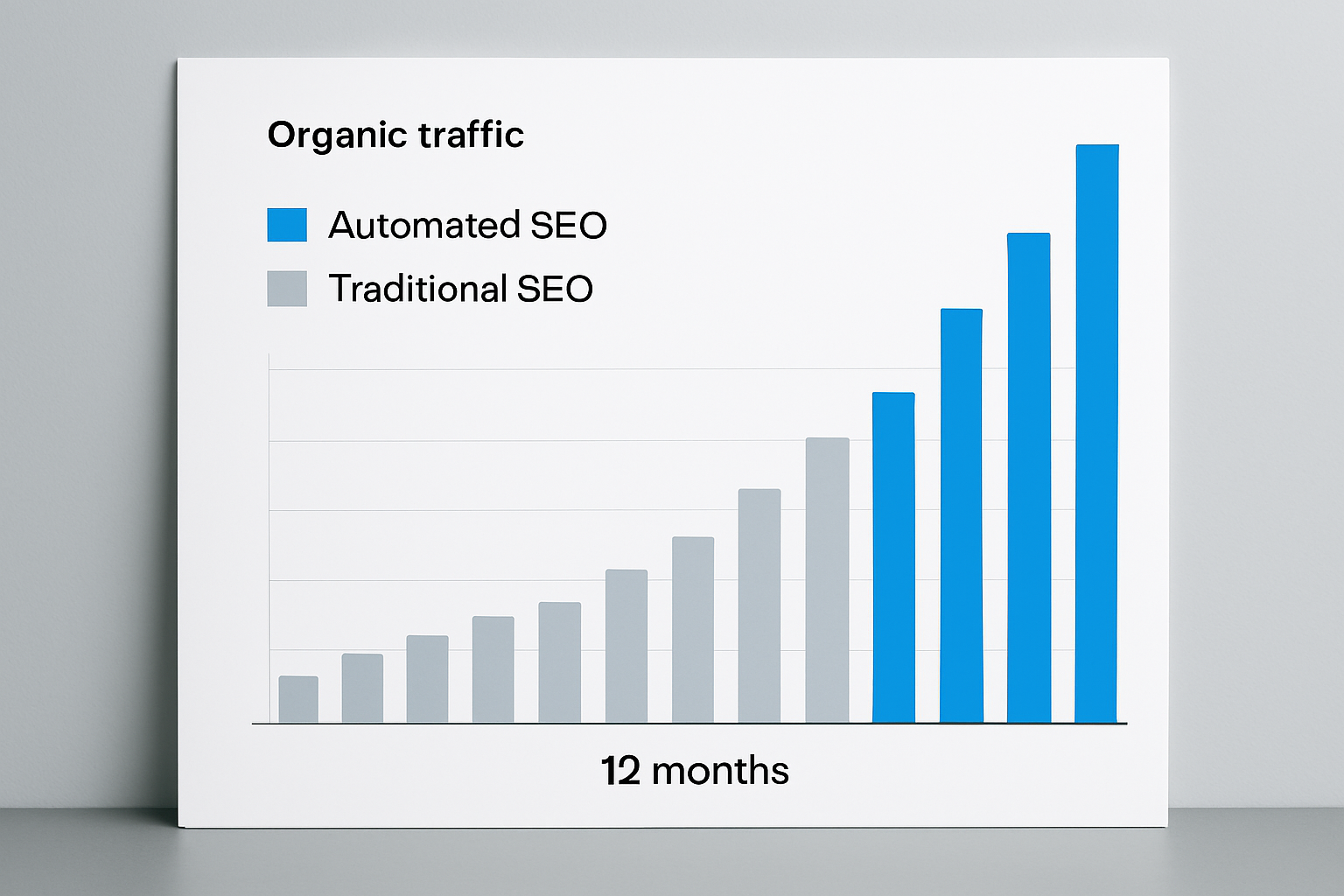
Enterprise SEO automation platforms deliver ROI through three primary mechanisms: time savings, error reduction, and faster ranking improvements. According to industry benchmarks, organizations that automate their SEO workflows see an average 34% increase in organic traffic within the first 12 months of platform adoption. That figure grows as automation matures and teams learn to act on insights more efficiently.
The cost of a missed SEO issue at enterprise scale is substantial. A single site-wide crawl error left undetected for two weeks can cost a large e-commerce brand hundreds of thousands of dollars in lost organic revenue. Automation eliminates this exposure by detecting and escalating issues in near real time. The platform cost is typically a fraction of the revenue protection it provides.
Long-term ROI also comes from competitive positioning. Organizations that adopt automation earlier build institutional knowledge and process maturity that are difficult for competitors to replicate quickly. This compounding advantage is one of the strongest arguments for investing in a comprehensive enterprise SEO automation platform SaaS rather than stitching together disconnected point solutions.
Why Choose a Modern SaaS Model Over Legacy SEO Tools?
Legacy platforms are defined as older, often desktop-based or on-premise SEO tools that were built before cloud computing became the standard delivery model for enterprise software. These tools typically require manual updates, have limited collaboration features, and struggle to process the data volumes that modern enterprise sites generate. The maintenance burden alone makes them a poor fit for fast-moving organizations.
Modern SaaS platforms update continuously, meaning your team always has access to the latest features and algorithm-aligned capabilities without waiting for a new software release cycle. They scale elastically with your crawl needs, support distributed teams across time zones, and reduce IT overhead significantly. For enterprise organizations already invested in cloud infrastructure, SaaS SEO tools are a natural fit.
The shift from legacy tools to SaaS is not merely a technology preference — it is a competitive necessity. As AI-driven search algorithms evolve at an accelerating pace, the ability to respond quickly with data-driven decisions separates organizations that grow organically from those that stagnate. SaaS platforms are simply better equipped to keep pace with that environment.
Frequently Asked Questions
What makes an SEO platform truly "enterprise-grade" versus a standard SEO tool?
An enterprise-grade SEO platform offers high-volume crawling, multi-user collaboration with role-based permissions, advanced API integrations, and security compliance features like SSO and SOC 2 certification. Standard tools lack the scalability and governance controls that large organizations require.
How long does it typically take to see results after implementing an enterprise SEO automation platform?
Most organizations begin seeing measurable improvements — such as faster issue resolution and incremental ranking gains — within 60 to 90 days of implementation. Significant organic traffic growth typically becomes visible within 6 to 12 months as automation matures.
Can an enterprise SEO automation platform SaaS handle multiple websites or domains simultaneously?
Yes, multi-domain management is a core feature of enterprise platforms. They allow teams to monitor, audit, and report on multiple websites, subdomains, and international site variants from a single unified dashboard.
Is it difficult to migrate from a legacy SEO tool to a modern enterprise SaaS platform?
Most modern enterprise SEO SaaS platforms provide onboarding support, data migration assistance, and integration guides to minimize disruption. Migration timelines vary but typically range from two to eight weeks depending on the complexity of your existing workflows.
How does an enterprise SEO automation platform handle AI-driven algorithm updates?
Leading enterprise platforms use machine learning models to monitor ranking fluctuations, correlate them with known algorithm signals, and surface prioritized recommendations for response. This allows SEO teams to adapt quickly rather than spending days diagnosing the root cause of a traffic change.
Start Scaling Your Enterprise SEO With the Right Platform
The right enterprise SEO automation platform SaaS can transform how your organization approaches organic search — moving from reactive firefighting to proactive, data-driven growth. Automation is not about replacing skilled SEO professionals; it is about amplifying their capabilities and removing the manual bottlenecks that slow progress. For enterprises serious about compounding their organic advantage, building on an automated foundation is the only sustainable path forward.
RankBloom SEO is built specifically for organizations that need enterprise-grade automation without the complexity and overhead of legacy platforms. From automated technical auditing and AI-powered keyword intelligence to real-time rank tracking and customizable reporting dashboards, RankBloom SEO brings everything an enterprise team needs into one streamlined, modern SaaS environment. The platform is designed to scale with your business, integrate with your existing tech stack, and deliver actionable insights from day one.
If your organization is ready to move beyond manual processes and fragmented tooling, explore what RankBloom SEO can do for your enterprise organic strategy. Schedule a demo today and see firsthand how intelligent automation can accelerate your path to measurable, lasting search visibility.