

AI-powered SEO content creation is the process of using artificial intelligence to research, write, optimize, and publish search-engine-friendly articles that attract organic traffic to your website. For small business owners and marketing teams, this approach eliminates the need to hire expensive writers or SEO specialists. In 2026, businesses that use AI to write SEO articles are publishing content up to five times faster than those relying on traditional methods.
What Exactly Is AI SEO Content Writing?
AI SEO content writing is defined as the use of large language models and natural language processing tools to automatically generate articles that are structured, keyword-optimized, and designed to rank in search engines like Google. These systems go far beyond simple text generation. They analyze search intent, competitor content structure, keyword placement, and readability — all in seconds.
Traditional content writing requires a human writer to research a topic, draft an article, revise it for SEO, and then format it for publishing. AI handles all of these steps in a fraction of the time. The result is a complete, optimized article ready to publish directly to your blog or website.
X is not just a buzzword here — AI content tools are now sophisticated enough to produce articles that rival professionally written copy. According to a 2025 HubSpot report, 68% of marketers using AI for content creation reported a significant increase in organic traffic within three months of adoption.
Why Should Small Businesses Use AI to Write SEO Articles?
The best way to understand the value of AI for SEO content is to compare the cost and time involved. Hiring a freelance SEO writer typically costs between $150 and $500 per article, and turnaround time can range from three to seven days. AI can produce a comparable article in under two minutes, at a fraction of that cost.
For small businesses, this changes everything. Instead of publishing one or two articles per month, you can realistically publish ten to twenty optimized pieces — dramatically increasing your topical authority and keyword coverage. More content means more entry points for potential customers to find your business through Google search.
Studies show that websites publishing at least 16 blog posts per month receive 3.5 times more traffic than those publishing four or fewer. AI makes that publishing frequency achievable for businesses without a dedicated content team. This is the core competitive advantage AI SEO content creation offers small businesses in 2026.
How Does AI Actually Write an SEO Article?
AI SEO writing works by combining several layers of intelligence into one automated workflow. First, the system analyzes the target keyword to understand search intent — whether users are looking for information, a product, or a local service. Then it structures the article using proven SEO frameworks like pillar content, listicles, or how-to guides.
Here is a simplified breakdown of how modern AI SEO tools generate an optimized article:
- Keyword analysis: The AI identifies the primary keyword, related terms, and semantic phrases that Google associates with the topic.
- SERP research: The system reviews the top-ranking pages to understand what structure, headings, and content depth Google rewards for that query.
- Content drafting: The AI writes the article using natural language, incorporating keywords at the appropriate density without stuffing.
- SEO formatting: Headings (H1, H2, H3), meta descriptions, internal link suggestions, and image alt text are automatically applied.
- Publishing: The finished article is pushed directly to your CMS — such as WordPress — scheduled and live.
Search engine optimization is defined as the practice of structuring online content so that search engines understand its relevance and rank it highly for specific user queries. AI automates this entire practice end to end, removing the technical complexity that once required a specialist.
What Kind of SEO Articles Can AI Write for Your Business?
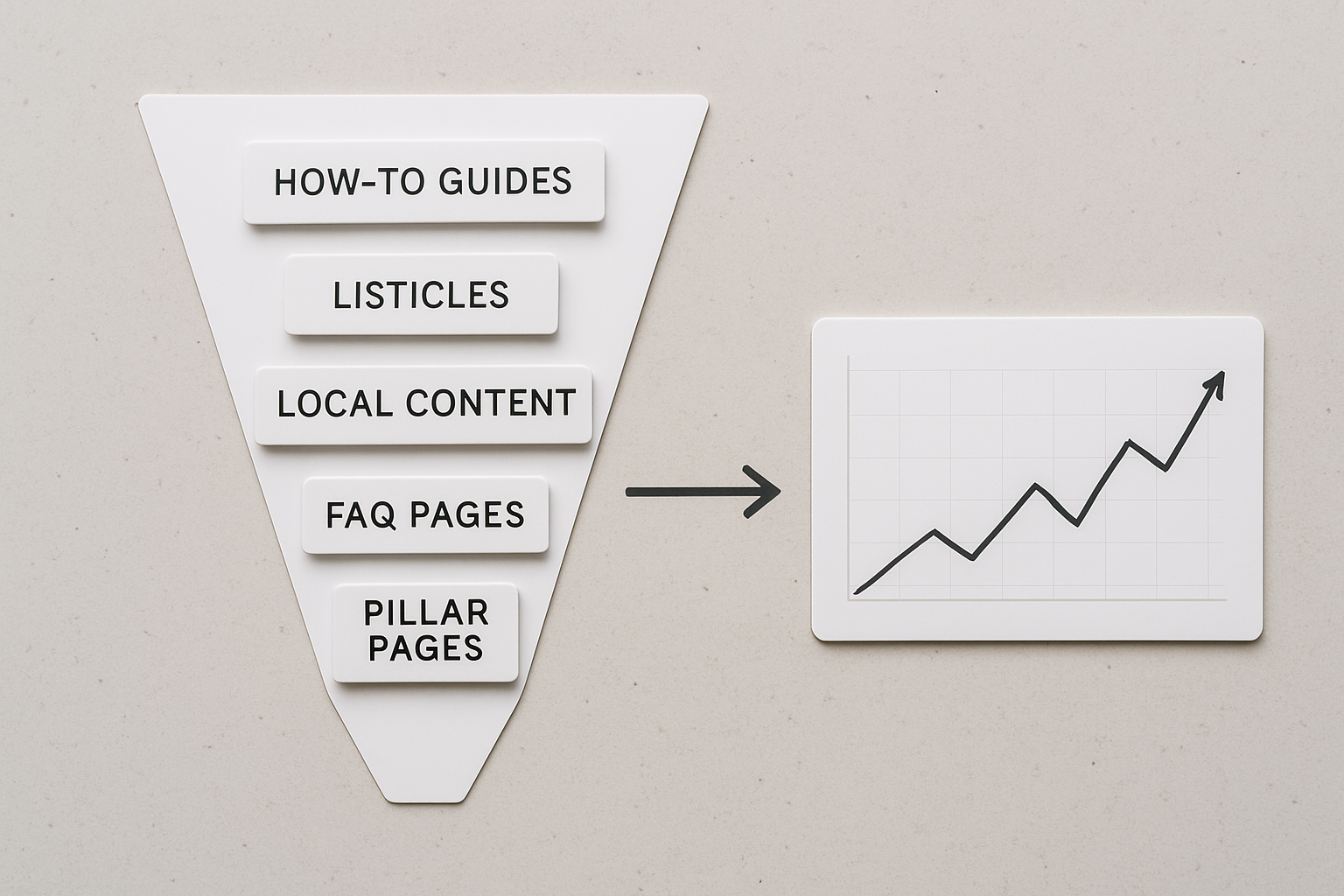
AI is versatile enough to write virtually any type of SEO content your business needs. The format you choose should match the search intent of your target audience and the stage of the buyer’s journey you are targeting.
Here are the most effective SEO article formats AI can produce for your business:
- How-to guides: Step-by-step articles that answer common questions in your industry (e.g., “How to choose the right accountant for your small business”).
- Listicles: Ranked or curated lists that are easy to skim and highly shareable (e.g., “7 Ways to Reduce Your Monthly Business Expenses”).
- Comparison articles: Content that helps buyers make decisions by comparing options, without you promoting competitors by name.
- Local SEO content: Location-specific articles that target city or neighborhood-based search queries relevant to your service area.
- FAQ articles: Long-form pages that answer multiple related questions, building topical authority and capturing featured snippet positions.
- Pillar pages: Comprehensive overviews of a broad topic that link to more specific cluster content on your site.
Each of these formats serves a different purpose in your SEO strategy. AI tools can generate all of them consistently, ensuring your content mix stays balanced and strategic.
How Do You Ensure AI-Generated SEO Articles Are High Quality?
Quality control is the most important step when using AI to write SEO articles for your business. AI outputs are only as good as the inputs you give them, and raw drafts should always be reviewed before publishing. The good news is that modern AI SEO platforms are designed to minimize the editing required.
What Makes an AI SEO Article High Quality?
A high-quality AI SEO article is defined as content that is accurate, readable, relevant to the target keyword, and structured in a way that satisfies both human readers and search engine algorithms. There are several key criteria to check before publishing.
- Factual accuracy: Verify any statistics, claims, or specific advice the AI includes. AI can sometimes produce outdated or hallucinated data points.
- Brand voice consistency: Add your business’s tone and personality. AI provides the structure; you add the authenticity.
- Internal linking: Make sure the article links to relevant pages on your website to support your overall site architecture.
- Originality: Use a plagiarism checker to confirm the content is unique, and avoid copying patterns from top-ranking competitors verbatim.
- Helpful first: Google’s Helpful Content guidelines require that articles genuinely serve the reader. Review each piece to confirm it answers the user’s question fully.
The review process for an AI-generated article typically takes fifteen to thirty minutes — compared to the hours required to write one from scratch. That time savings compounds quickly when you are publishing multiple articles per week.
How Important Is Keyword Research Before Using AI?
Keyword research is the foundation of any AI SEO content strategy. Without a clear target keyword, even the best AI writing tool will produce content that fails to rank. You need to identify what your potential customers are actually searching for before you ask AI to write anything.
Start by thinking about the questions your customers ask most frequently. Then use keyword research methods to validate search volume and competition. Focus on long-tail keywords — phrases of three to five words — because they have lower competition and higher purchase intent than broad, single-word terms.
According to research by Backlinko, long-tail keywords account for 70% of all search queries. Targeting these specific phrases with AI-generated content is one of the fastest ways for a small business to gain organic visibility without competing against massive brands.
What Are the Common Mistakes Businesses Make When Using AI for SEO Content?
Mistakes in AI SEO content creation can waste time, damage your brand reputation, and even trigger Google penalties. Understanding these pitfalls upfront will save you from costly errors.
Here are the most common mistakes to avoid:
- Publishing without reviewing: Never publish AI-generated content without a human review. Errors, outdated facts, and off-brand messaging can slip through unedited drafts.
- Over-stuffing keywords: AI tools can sometimes over-optimize if given poor instructions. Natural keyword usage matters more than hitting an exact percentage.
- Ignoring search intent: Writing a product-focused article for an informational query — or vice versa — will prevent the content from ranking, regardless of how well it is written.
- Skipping internal linking: Publishing articles that exist in isolation hurts your site architecture. Each article should link to and from other relevant pages on your site.
- Expecting overnight results: SEO is a long-term strategy. AI accelerates content production, but it does not bypass the time Google takes to crawl, index, and rank new content.
- Using generic prompts: Vague instructions produce vague content. Always give your AI tool specific context about your business, audience, and keyword before generating an article.
Avoiding these mistakes is the difference between an AI content strategy that builds compounding organic traffic and one that produces a library of articles nobody ever reads. Precision in inputs leads to precision in outputs.
How Can You Build a Sustainable AI SEO Content Strategy for Your Business?
A sustainable AI SEO strategy is built on consistency, relevance, and topical depth — not volume for its own sake. The goal is to become the most comprehensive and helpful resource in your niche, so Google recognizes your site as an authority.
What Does a Monthly AI SEO Content Plan Look Like?
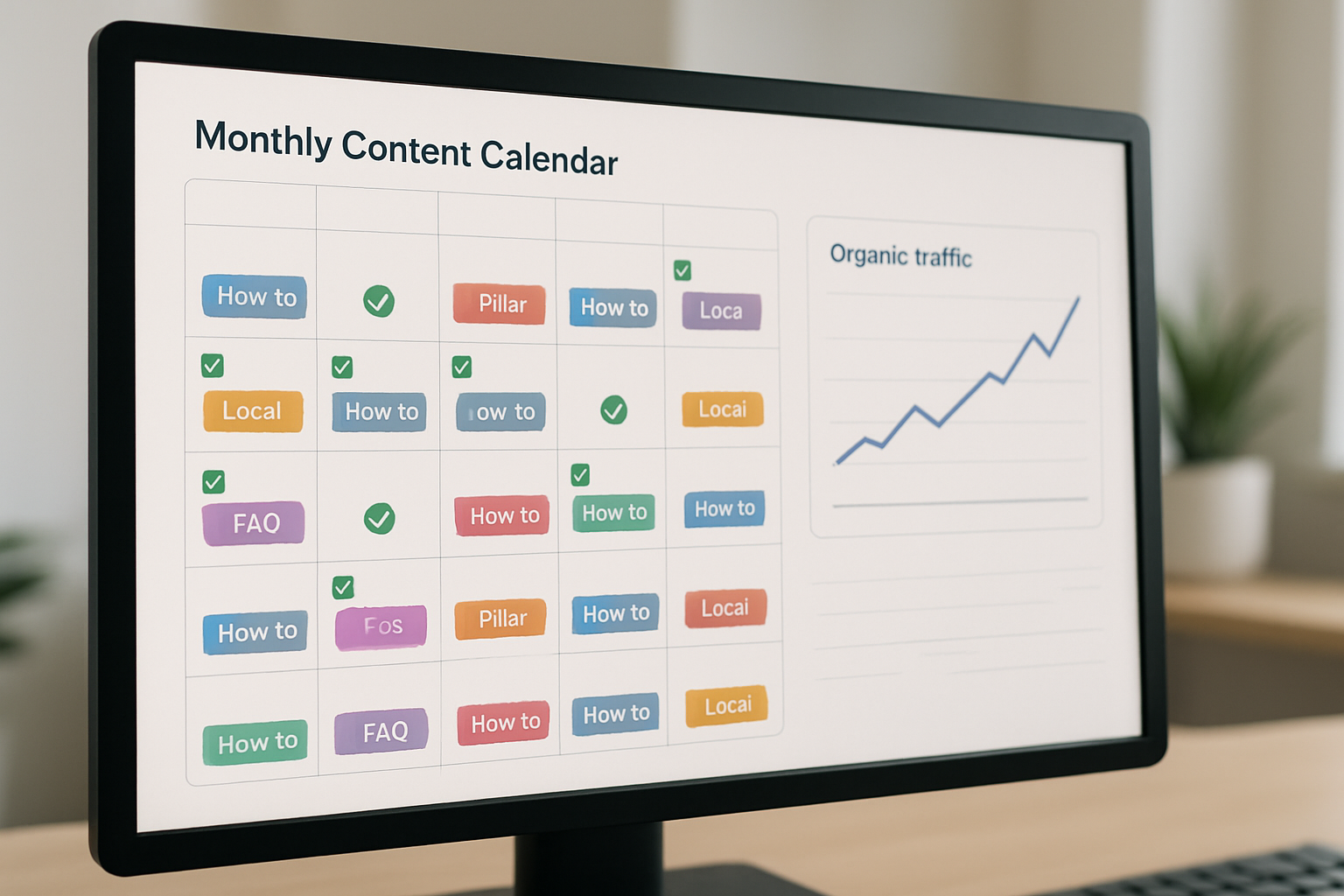
Start by mapping out the core topics that matter most to your target audience. Group related keywords into topic clusters, with one pillar article covering the broad topic and three to five supporting articles covering specific subtopics. This structure signals topical authority to Google and keeps visitors engaged longer on your site.
Here is a simple monthly AI SEO content plan for a small business:
| Week | Content Type | Goal |
|---|---|---|
| Week 1 | Pillar article (1,500–2,500 words) | Establish topical authority |
| Week 2 | 2 supporting how-to articles | Target long-tail keywords |
| Week 3 | Local SEO article + FAQ article | Capture local and voice search |
| Week 4 | Listicle or comparison article | Target mid-funnel buyers |
Following this cadence with AI tools means you are producing seven to eight optimized articles per month with minimal manual effort. Over twelve months, that builds a library of nearly one hundred pieces of indexed content driving traffic around the clock.
Why Is RankBloom SEO the Smartest Way to Use AI for Business Content?
RankBloom SEO is a SaaS platform purpose-built to automate the entire AI SEO content creation workflow for small businesses and marketing agencies. Unlike generic writing tools or legacy SEO platforms that require you to piece together multiple subscriptions, RankBloom SEO handles everything in one place — from keyword selection and article generation to scheduling and direct publishing to WordPress.
The platform is designed specifically for business owners who want to rank on Google without hiring a full-time writer or SEO specialist. You do not need technical knowledge to use it. You simply input your target keyword and business context, and RankBloom SEO generates a fully optimized, publish-ready article that goes live on your site automatically.
What sets RankBloom SEO apart is its end-to-end automation. Most tools stop at content generation and leave you to handle formatting, scheduling, and publishing manually. RankBloom SEO closes that gap entirely, making it the most complete AI SEO solution available for businesses that want results without the complexity.
Ready to start ranking on Google with AI-powered SEO content? Visit https://www.rankbloomseo.com and see how RankBloom SEO can automate your content strategy starting today.
—
Frequently Asked Questions
Can AI really write SEO articles good enough to rank on Google?
Yes — AI-generated SEO articles can and do rank on Google when they are properly keyword-targeted, well-structured, and reviewed for accuracy before publishing. The key is combining AI's speed and optimization capabilities with a human review for quality and brand voice.
How many AI SEO articles should I publish per month to see results?
Publishing eight to sixteen optimized articles per month is considered the threshold for meaningful organic traffic growth, according to multiple content marketing studies. Consistency over time matters more than publishing in short bursts — a steady cadence builds compounding results.
Do I need SEO experience to use AI to write articles for my business?
No — modern AI SEO platforms like RankBloom SEO are designed so that business owners with no technical background can generate and publish optimized content. The AI handles keyword placement, heading structure, meta descriptions, and formatting automatically.
Will Google penalize my website for using AI-generated content?
Google's official position is that it rewards helpful, high-quality content regardless of whether it was written by a human or AI. The risk comes from publishing unreviewed, low-quality, or spammy AI content — not from using AI responsibly as part of a genuine content strategy.
How long does it take for AI SEO articles to start ranking on Google?
Most AI-generated SEO articles begin to appear in Google's index within one to four weeks of publishing, but significant ranking improvements typically develop over three to six months. Targeting long-tail, lower-competition keywords can accelerate your results considerably in the early stages.
—
Start Using AI to Write SEO Articles and Grow Your Business Faster
Using AI to write SEO articles for your business is no longer a futuristic concept — it is the most practical, cost-effective content strategy available to small businesses and agencies in 2026. The combination of speed, consistency, and optimization that AI delivers makes it impossible to ignore if organic traffic growth is a priority for your business.
The businesses winning on Google right now are not those with the biggest budgets — they are the ones publishing the most relevant, well-structured content consistently. AI is the great equalizer that puts that capability within reach for any business, regardless of size or technical expertise.
RankBloom SEO is built to make this entire process effortless. From generating your first keyword-optimized article to scheduling and publishing it directly to your WordPress site, RankBloom SEO handles everything so you can focus on running your business. Visit https://www.rankbloomseo.com today to start building the SEO content engine your business deserves.