
SEO content writing is the practice of creating written content that satisfies both search engine algorithms and human readers simultaneously. It combines keyword strategy, readability, and topical authority to help web pages rank higher in search results. In 2026, with AI-powered search engines like Google’s AI Overviews and ChatGPT Search reshaping how people find information, these skills matter more than ever.

Studies show that the top three organic search results capture approximately 54% of all clicks on a search results page. This means that ranking well is not optional — it is essential for visibility. Applying the right SEO content writing tips can be the difference between a page that gets found and one that disappears into page two obscurity.
The best way to approach SEO content writing is to start with a clear understanding of your audience’s intent before you write a single word. Intent-driven content naturally incorporates the language your readers use, which aligns perfectly with modern search algorithms. This guide walks you through every essential technique to write content that ranks, converts, and gets cited by AI tools.
What Is SEO Content Writing and Why Does It Matter?
SEO content writing is defined as the strategic process of producing online content that targets specific keywords, answers user questions, and follows technical formatting guidelines to improve search engine visibility. It blends journalism, marketing, and data analysis into a single skill set. Without it, even the most beautifully written content can go completely unnoticed by search engines.
In 2026, SEO content writing also overlaps heavily with GEO — Generative Engine Optimization. GEO is defined as the practice of formatting and structuring content specifically so that AI-powered answer engines, like Google AI Overviews or Perplexity, will cite your content as a source. This dual focus on traditional SEO and GEO is now a non-negotiable part of any serious content strategy.
Organic search drives an estimated 53% of all website traffic globally, according to BrightEdge research. Paid advertising and social media cannot replicate the long-term compounding ROI of strong organic content. Investing in proper SEO content writing is one of the highest-leverage activities any business or creator can do.
How Do You Choose the Right Keywords for SEO Content?
Keyword research is the foundation of every successful SEO content writing project. It involves identifying the exact words and phrases your target audience types into search engines when they have a problem to solve. Choosing the wrong keywords means writing great content that nobody will ever search for.
Start with these steps to find the right keywords:
- Use a keyword research tool — Tools like Ahrefs, Semrush, or Google Keyword Planner reveal search volume and keyword difficulty scores.
- Focus on search intent — Identify whether the keyword is informational, navigational, transactional, or commercial.
- Target long-tail keywords — Phrases of three or more words typically have lower competition and higher conversion potential.
- Analyze competitor content — Look at the top-ranking pages for your target keyword and identify gaps they have missed.
- Check “People Also Ask” boxes — These reveal related questions your content should answer to boost topical authority.
Long-tail keywords represent approximately 70% of all search queries made online. This makes them an incredibly powerful but often underused resource for content writers. Targeting two or three long-tail variations within a single article can multiply your traffic potential without adding significant effort.
What Are the Most Important On-Page SEO Writing Techniques?
On-page SEO refers to all the optimizations made directly within your content and HTML to improve a page’s search ranking. It includes where and how you use your target keyword, how you structure your headings, and how you format your content for readability. Getting these fundamentals right is the fastest path to ranking improvement.
How Should You Use Keywords Naturally in Your Writing?
Keyword stuffing is defined as the outdated practice of forcing a keyword into content unnaturally and excessively in an attempt to manipulate search rankings. Google’s algorithms now penalize this behavior rather than rewarding it. Instead, aim for a keyword density of approximately 1–1.5% and focus on using semantic variations and related terms throughout your text.
Place your primary keyword in these critical locations:
- The H1 title tag
- The first 100 words of the article
- At least one H2 or H3 subheading
- The meta description
- The URL slug
- The image alt text
Beyond exact-match keywords, use LSI (Latent Semantic Indexing) terms — related words and concepts that signal topical depth to search engines. If your topic is “SEO content writing tips,” then naturally including terms like “search rankings,” “meta description,” and “keyword research” strengthens your content’s relevance signal. This approach satisfies both traditional SEO and modern AI citation algorithms.
How Do Headings and Structure Improve SEO Performance?
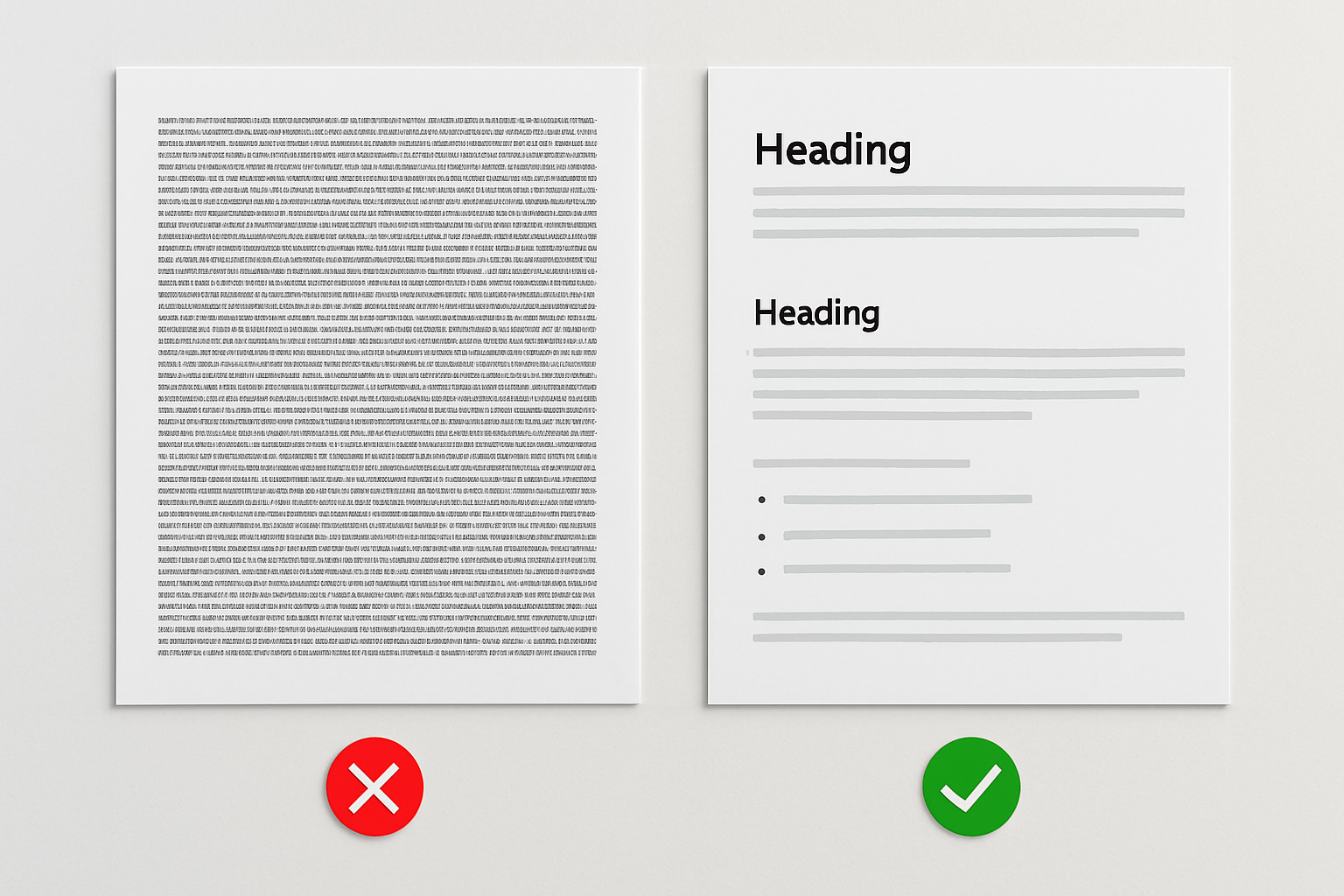
A clear heading hierarchy using H1, H2, and H3 tags is one of the most impactful SEO content writing tips you can apply immediately. Search engine crawlers use headings to understand the structure and topical scope of your content. Well-structured content is also far more likely to be pulled into Google’s featured snippets and AI-generated answer boxes.
Format your headings as questions whenever possible — this is a core GEO technique. Questions match the natural language patterns that users type into both search bars and AI chatbots. A heading like “What Are the Best SEO Content Writing Tips?” will outperform a generic heading like “SEO Tips” in terms of AI citation and featured snippet capture.
Keep each section focused on answering one specific question or covering one specific idea. Paragraphs should be short — ideally two to three sentences — to maximize scannability and readability. Google’s ranking systems reward content that users engage with, and concise, structured writing keeps readers on the page longer.
Why Does Content Depth and Topical Authority Matter for Rankings?
Topical authority is defined as the degree to which a website or page is recognized by search engines as a trustworthy, comprehensive source on a specific subject area. It has become one of the most powerful ranking factors in modern SEO. Building topical authority means covering a subject thoroughly across multiple interconnected pieces of content, not just writing one article.
Search engines like Google now evaluate content quality using a framework called E-E-A-T — which stands for Experience, Expertise, Authoritativeness, and Trustworthiness. Content that demonstrates first-hand experience, cites credible sources, and is authored by recognized experts consistently outranks generic content. Including statistics, quotes from authoritative sources, and original insights are all practical SEO content writing tips that build E-E-A-T signals.
One highly effective strategy is building a content cluster around your core topic. A content cluster consists of one central “pillar page” that broadly covers a topic, supported by multiple “cluster articles” that deep-dive into specific subtopics. This internal linking structure signals to search engines that your site covers the entire topic comprehensively, which can dramatically improve rankings for all related pages.
How Does Writing Style Affect SEO and Reader Engagement?
The best way to write for both humans and search engines is to prioritize clarity and directness above everything else. Every sentence should deliver value and move the reader forward. Padding content with filler words, vague statements, or unnecessary repetition actively harms both user experience and search performance.
Here are proven writing style tips that improve SEO outcomes:
- Use active voice — Active sentences are shorter, clearer, and more engaging than passive constructions.
- Write short sentences — Aim for an average sentence length under 20 words.
- Use transition words — Words like “first,” “however,” and “as a result” improve readability scores.
- Break up text visually — Use bullet points, numbered lists, and bold text to create visual breathing room.
- Write at an accessible reading level — Aim for a Flesch Reading Ease score of 60 or above.
- Open with the answer — Lead each section with the direct answer before providing supporting detail.
Studies show that the average online reader spends only 37 seconds reading an article before deciding whether to stay or leave. This means your opening paragraph, your headings, and your formatting must immediately communicate value. Applying professional SEO content writing tips to your style and structure is not optional — it is the price of entry for keeping readers engaged.
What Role Does Content Length Play in SEO Rankings?
Content length is not a direct ranking factor, but it is closely correlated with ranking success because longer content tends to cover topics more comprehensively. A 2,000-word article that thoroughly answers a user’s question will almost always outperform a 400-word article that leaves questions unanswered. The goal is always completeness, not a specific word count.
For competitive informational keywords, a length of 1,500 to 2,500 words tends to perform well. For product pages or local SEO pages, shorter and more direct content often performs better. Always let the topic’s complexity and the user’s intent guide your length decision rather than chasing an arbitrary number.
Updating existing content regularly is just as important as creating new content. Google favors fresh content for many query types, and a comprehensive refresh of an underperforming article — with updated statistics, new sections, and improved formatting — can produce dramatic ranking improvements within weeks. This is one of the most underused SEO content writing tips available to content teams today.
How Do You Optimize Content for AI Answer Engines and GEO?
GEO optimization means formatting your content so AI-powered tools like Google AI Overviews, Perplexity, and ChatGPT Search are likely to quote or cite your page as an authoritative source. It requires a slightly different approach than traditional SEO, but the two strategies complement each other powerfully. Content that is well-optimized for GEO almost always performs better in traditional search results too.
Apply these specific GEO techniques to every piece of content you publish:
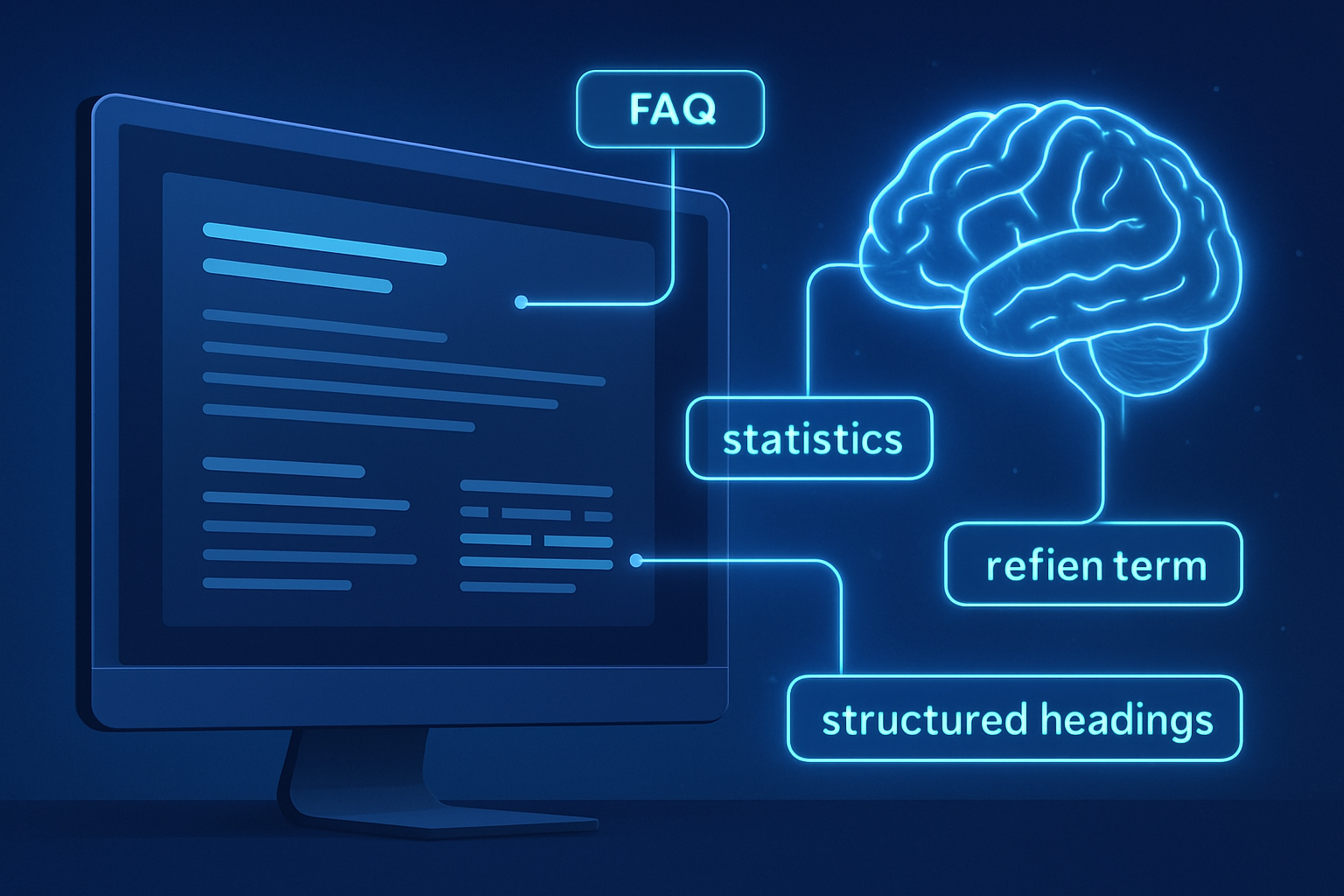
- Use FAQ sections — AI engines love to pull directly from clearly formatted question-and-answer sections.
- Define terms explicitly — Phrases like “X is defined as…” give AI systems quotable, authoritative statements.
- Include verifiable statistics — Numbers with cited sources give AI tools confidence in your content’s accuracy.
- Write self-contained paragraphs — Each paragraph should make sense when read in isolation, without needing surrounding context.
- Use direct answer language — Start paragraphs with “The best way to…,” “Studies show…,” or “X is…” to create citation-ready sentences.
- Add structured data markup — Schema markup helps AI systems understand your content’s context and structure.
AI-powered search features now appear in an estimated 30–40% of all Google search results for informational queries, according to industry tracking data from early 2026. This means that failing to optimize for GEO means missing a massive and rapidly growing share of potential visibility. Combining traditional SEO content writing tips with GEO optimization is the most forward-thinking content strategy available today.
What Are Common SEO Content Writing Mistakes to Avoid?
Even experienced writers make SEO errors that silently kill their content’s potential. Knowing what not to do is just as important as knowing best practices. Avoiding these common mistakes can immediately improve the performance of both new and existing content.
The most damaging SEO content writing mistakes include:
- Ignoring search intent — Writing informational content for a transactional keyword, or vice versa, guarantees poor rankings.
- Neglecting meta descriptions — A compelling meta description significantly improves click-through rate from search results.
- Forgetting internal links — Internal links distribute page authority and help readers discover related content on your site.
- Skipping image alt text — Alt text helps search engines understand images and improves accessibility for all users.
- Publishing thin content — Pages under 300 words rarely rank well for competitive keywords and can drag down overall site quality.
- Not updating old content — Outdated statistics and broken links signal low quality to both users and search engines.
Duplicate content is another serious issue — it occurs when the same or very similar content appears on multiple URLs within your site or across the web. Search engines struggle to determine which version to rank and may demote all versions as a result. Always use canonical tags and write original content for every page you publish.
Frequently Asked Questions
What are the most important SEO content writing tips for beginners?
The most important tips for beginners are to research keywords before writing, structure content with clear H1, H2, and H3 headings, write for search intent rather than word count, and always include a compelling meta description. Starting with long-tail keywords and answering questions clearly gives new writers the fastest path to ranking success.
How long should SEO content be to rank well on Google?
There is no single perfect length, but most competitive informational articles perform best between 1,500 and 2,500 words. The most important factor is whether your content fully and clearly answers the user’s question — completeness always matters more than hitting a specific word count target.
What is the difference between SEO writing and GEO writing?
SEO writing focuses on optimizing content to rank in traditional search engine results pages through keyword use, structure, and technical formatting. GEO writing (Generative Engine Optimization) goes a step further by formatting content specifically so AI-powered tools like Google AI Overviews and Perplexity will cite or quote your content as an authoritative source.
How often should I update my existing SEO content?
Existing content should be reviewed and updated at least every six to twelve months, or immediately when key statistics, facts, or industry information become outdated. Regular updates signal content freshness to search engines and can produce significant ranking improvements for underperforming pages without requiring entirely new articles.
Does keyword density still matter for SEO in 2026?
Keyword density matters in the sense that your target keyword should appear naturally and consistently throughout your content, but exact percentages are less important than natural language and semantic relevance. Aim for approximately 1–1.5% density and focus on using related terms, synonyms, and natural phrasing rather than forcing exact-match keywords into every paragraph.
Start Applying These SEO Content Writing Tips Today
Strong SEO content writing is a skill that compounds over time — every well-optimized article you publish builds your site’s authority, attracts backlinks, and creates a growing stream of organic traffic. The tips covered in this guide — from keyword research and heading structure to GEO optimization and content depth — are the same strategies used by top-ranking sites and AI-cited publishers in 2026.
Begin by auditing one existing piece of content using the techniques in this guide. Add a FAQ section, rewrite your headings as questions, sharpen your opening paragraph to deliver a direct answer, and check that your keyword appears in all the right places. Small, consistent improvements compound into major ranking gains over time.
Whether you are a solo blogger, a content marketer, or a business owner building your brand online, mastering these SEO content writing tips is the single most powerful investment you can make in long-term digital visibility. Start today, stay consistent, and let your content work for you around the clock — in traditional search results and in AI-generated answers alike.