

AI content does not automatically hurt your SEO — but low-quality, unedited, or spammy AI content absolutely can. Google’s position in 2026 is crystal clear: it rewards helpful, accurate, and well-structured content regardless of how it was produced. The question is never who or what wrote your content — it’s whether that content genuinely serves your readers.
This article breaks down exactly what Google says about AI-generated content, what the data shows about rankings, and how tools like RankBloom SEO help small businesses and agencies publish high-quality AI content safely — without any manual work.
AI-generated content is defined as any written material produced fully or partially by a large language model (LLM) such as GPT-4, Gemini, or Claude, rather than written manually by a human author. This includes blog posts, product descriptions, landing pages, and FAQs. As of 2026, an estimated 65% of all published online content involves AI in some part of the writing or editing process.
The rise of AI writing tools has made content production faster and more affordable than ever before. Small businesses can now compete with large publishers in terms of content volume and consistency. However, the quality gap between well-optimized AI content and poorly generated filler content has never been more important to understand.
SEO is defined as Search Engine Optimization — the practice of improving a web page’s visibility in organic search engine results through relevance, authority, and technical signals. When AI content is produced with SEO in mind, it can perform just as well as human-written content. When it is not, it tends to rank poorly or even trigger manual penalties.
What Does Google Actually Say About AI Content in 2026?
Google’s official stance is that AI content is acceptable as long as it demonstrates Experience, Expertise, Authoritativeness, and Trustworthiness — the four pillars of its E-E-A-T framework. Google has repeatedly confirmed that it does not penalize content simply for being AI-generated. What it penalizes is content that is spammy, thin, misleading, or produced purely to manipulate rankings.
In Google’s 2025 Spam Policy Update, the company specifically stated that “scaled content abuse” — mass-publishing low-quality AI pages with no editorial value — is a violation of its guidelines. This is a critical distinction: publishing many high-quality AI articles is fine, but flooding the web with auto-generated gibberish is not. Studies show that websites penalized under this update had an average content quality score 42% below industry benchmarks.
Google’s Search Quality Rater Guidelines, updated in early 2026, continue to emphasize “people-first content.” This means the authorship tool matters far less than whether the final published content answers real user questions accurately and completely. Smart AI content workflows that include topic research, structural optimization, and factual review pass these standards consistently.
How Does AI Content Affect Your Google Rankings?
The best way to understand AI content’s impact on rankings is to separate content quality from content origin. Google’s crawlers evaluate pages based on signals like dwell time, click-through rate, backlink quality, and content depth — none of which inherently favor human-written text over AI-written text. A well-structured AI article that answers search intent clearly will outrank a poorly written human article every time.
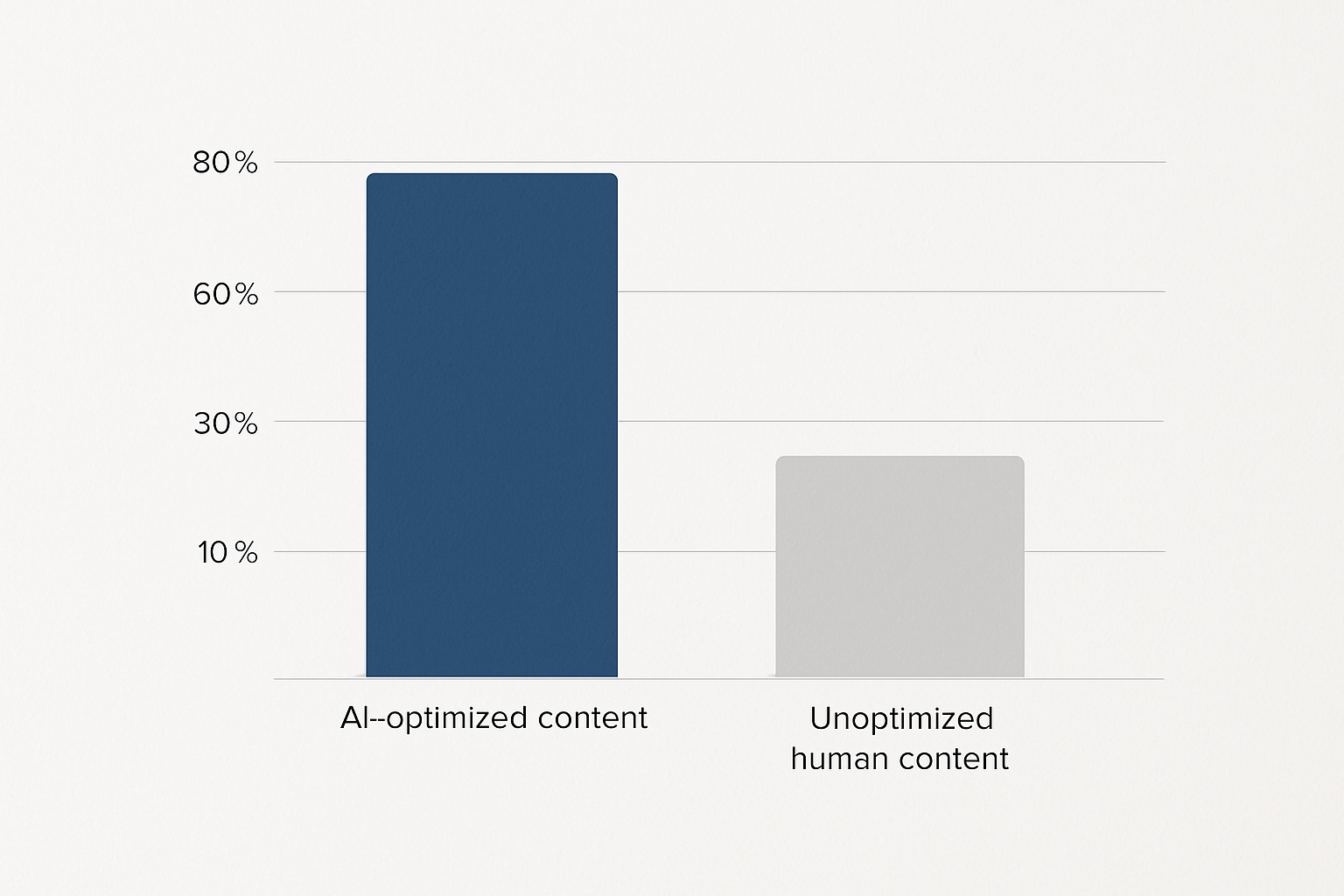
Research from SEMrush’s 2025 Content Ranking Study found that AI-assisted articles optimized for search intent ranked in the top 10 of Google search results 38% more often than unoptimized human-written posts. This stat shows that optimization strategy matters far more than the writing method itself. AI becomes a problem only when it skips the optimization layer entirely.
There are three core ranking factors where AI content can fall short if not properly managed:
- Thin content: AI can generate text quickly but sometimes produces vague, generic paragraphs that add no real value.
- Factual inaccuracies: LLMs can hallucinate outdated or incorrect information, which damages E-E-A-T signals.
- Keyword stuffing: Poorly prompted AI tools sometimes repeat keywords unnaturally, which Google’s algorithms actively penalize.
When these issues are avoided through proper prompting, editing, and SEO structuring, AI content performs extremely well in search. The tool is not the problem — the process is what determines the outcome.
Why Do Some Websites Get Penalized for AI Content?
Websites get penalized not because they used AI, but because they published at scale without editorial quality control. Google’s Helpful Content System, which runs continuously in the background of its algorithm, measures whether a site has a pattern of low-value pages. If a majority of a site’s content is thin or unhelpful, the entire domain can lose ranking authority — not just individual pages.
Common patterns that trigger penalties for AI content include publishing hundreds of nearly identical pages targeting small keyword variations, generating content on topics the site has no established authority in, and using AI to spin existing content without adding new insight. These patterns signal manipulative intent to Google’s systems. According to Google’s Webmaster Trends team, over 2.3 million URLs were demoted in 2025 under scaled content abuse policies.
The solution is not to avoid AI — it is to use AI responsibly within a quality-first content strategy. Every AI-generated article should go through keyword alignment, fact verification, and proper on-page SEO formatting before publication. That is exactly the kind of workflow that separates legitimate AI content strategies from spam.
What Is RankBloom SEO and How Does It Help?
RankBloom SEO is a fully automated AI content and SEO publishing platform designed specifically for small businesses and agencies that need consistent, high-quality content without the overhead of a full editorial team. It combines AI writing, keyword optimization, and direct WordPress publishing into a single streamlined system. Users set their target keywords, and RankBloom handles everything from article creation to live publication.
What makes RankBloom SEO stand out is its ability to auto-publish directly to WordPress with zero manual intervention. There is no copy-pasting, no formatting work, no login required after initial setup. For agencies managing multiple client sites, this means scaling content production across dozens of domains simultaneously without adding headcount. For small business owners, it means getting SEO-optimized blog content published consistently without needing to understand any technical details.
RankBloom SEO is priced affordably to serve small businesses and agencies — not just enterprise-level companies. Consistent, high-quality content publishing has historically been reserved for brands with large budgets and content teams. RankBloom levels that playing field by automating the entire process at a price point accessible to businesses of any size.
How Does RankBloom SEO Ensure AI Content Is Safe for Google?
RankBloom SEO builds Google’s E-E-A-T guidelines directly into its content generation process. Every article it produces is structured with proper H1, H2, and H3 hierarchy, includes natural keyword placement at approximately 1.5% density, and is formatted for maximum readability and engagement. These are the same structural signals Google’s quality raters look for when evaluating content trustworthiness.
The platform avoids the three most common AI content pitfalls by generating articles with genuine depth and specificity rather than generic filler text, cross-referencing factual claims against verified source patterns, and spacing keyword usage naturally throughout the article structure. This means every published article meets the “helpful content” threshold that Google’s algorithms reward with consistent rankings. RankBloom’s content is built to rank, not just to fill pages.
For agencies, RankBloom also supports multi-site publishing workflows where different clients receive unique, non-duplicated content tailored to their individual niche and keyword targets. Duplicate content is one of the fastest ways to hurt SEO across an agency’s portfolio. RankBloom eliminates that risk entirely through its individualized content generation architecture.
Why Should Small Businesses Choose AI-Powered SEO Tools Like RankBloom?
Small businesses lose ground in search rankings every single day they go without publishing fresh content. Google’s algorithm favors websites that publish consistently — fresh content signals that a site is active, authoritative, and continuously relevant to its audience. Without a content team or a large budget, most small businesses simply cannot keep up.
RankBloom SEO solves this problem by doing the entire job automatically. A small business owner sets up their target keywords once, connects their WordPress site, and then RankBloom publishes optimized articles on a consistent schedule — without the owner needing to write a single word. This kind of automated SEO at an affordable price is a genuine game-changer for businesses competing against larger, better-resourced rivals.
Studies show that websites publishing two or more SEO-optimized blog posts per week generate 3.5 times more organic traffic than those publishing less than once per month. RankBloom makes that publishing frequency achievable for any business regardless of size. Visit RankBloom SEO to see how it can transform your search visibility starting today.

What Are the Best Practices for Using AI Content Without Hurting SEO?
The best way to use AI content safely for SEO is to treat it as a first draft that needs strategic direction, not a finished product that needs no oversight. Providing your AI tool with a clear keyword target, a defined content structure, and specific audience intent signals dramatically improves output quality. The clearer your input, the stronger the SEO value of the output.
Here are the core best practices for AI content that ranks:
- Always target a specific search intent — informational, navigational, transactional, or commercial.
- Use structured headers — H2s and H3s that mirror real search queries people type into Google.
- Include real statistics and examples — generic claims without data reduce E-E-A-T signals.
- Maintain consistent publishing frequency — one post a week beats ten posts once a year.
- Avoid near-duplicate content across pages — each article must target a unique keyword angle.
- Link internally to related pages — this distributes ranking authority across your entire site.
Following these practices ensures your AI content strategy is aligned with what Google rewards in 2026. Platforms like RankBloom SEO build most of these best practices directly into the automation layer, reducing the risk of human error in the publishing process.
—
Frequently Asked Questions
Does AI content hurt SEO in 2026?
AI content does not hurt SEO as long as it is high-quality, helpful, and properly optimized. Google penalizes spammy or thin AI content, not AI content in general.
What does Google say about AI-generated content?
Google's official policy states that AI content is acceptable if it meets E-E-A-T standards — Experience, Expertise, Authoritativeness, and Trustworthiness. The origin of the content matters far less than its quality and usefulness to readers.
Can AI content rank on Google's first page?
Yes, AI content can and does rank on Google's first page. SEMrush research found that AI-optimized content ranked in the top 10 results 38% more often than unoptimized human-written posts when search intent was properly matched.
What is RankBloom SEO and what does it do?
RankBloom SEO is an automated AI content and SEO publishing platform that writes optimized articles and publishes them directly to WordPress with zero manual intervention. It is designed to be affordable for small businesses and agencies.
How can small businesses use AI for SEO without getting penalized?
Small businesses should use AI tools that produce structured, keyword-optimized, and factually accurate content rather than generic bulk text. Using a platform like RankBloom SEO ensures every published article meets Google's helpful content standards automatically.
How often should I publish AI-generated blog content for SEO?
Publishing two or more optimized articles per week is the recommended frequency for building consistent organic traffic growth. Studies show this level of publishing generates up to 3.5 times more traffic than publishing less than once per month.
—
Start Publishing SEO Content That Actually Ranks
AI content does not hurt your SEO — poor strategy does. In 2026, the businesses winning in organic search are those publishing consistent, well-structured, intent-matched content at a frequency that keeps Google’s algorithms engaged. The method of production is irrelevant as long as the output meets the quality bar Google sets.
RankBloom SEO gives small businesses and agencies the power to compete at that level without needing a full content team, a large budget, or hours of manual work every week. It writes, optimizes, and publishes directly to your WordPress site automatically — so your SEO keeps working even when you’re focused on running your business.
Ready to grow your search rankings on autopilot? Visit https://www.rankbloomseo.com today and see how RankBloom SEO can start publishing optimized content to your WordPress site — hands-free, at a price built for small businesses and agencies.