
A scalable SEO solution for growing marketing teams is a system, platform, or workflow designed to expand in capacity, output, and efficiency as your team size, content volume, and keyword targets increase — without requiring a proportional increase in budget or headcount. Marketing teams hit a painful wall when their SEO strategy stops keeping up with business growth. The good news is that with the right approach, that wall doesn’t have to exist.

Studies show that 68% of all online experiences begin with a search engine, making SEO one of the highest-leverage investments a marketing team can make. Yet many growing teams continue to operate with tools and processes built for individual contributors rather than collaborative, high-output departments. That mismatch creates bottlenecks, missed opportunities, and wasted budget.
This article breaks down exactly what a scalable SEO solution looks like, how to build one for your team, and what features to prioritize as you grow. Whether you’re a team of three or thirty, the principles here apply — and they compound over time.
What Does “Scalable SEO” Actually Mean for a Marketing Team?
Scalable SEO is defined as an approach to search engine optimization that maintains or improves performance and efficiency as the volume of tasks, campaigns, and team members increases. It’s the opposite of a strategy that requires you to manually repeat every step every time you add a new page, keyword cluster, or campaign. True scalability means your processes do more work without requiring more hours.
For a growing marketing team, scalability shows up in three key areas: content production, technical auditing, and performance reporting. When any one of those three is handled manually at scale, the whole system slows down. When all three are systematized, teams can grow their organic presence without burning out their people.
The difference between a scalable and a non-scalable SEO strategy is often less about budget and more about architecture. Teams that plan their taxonomy, content clusters, and tooling early — before they hit high volume — scale much more smoothly than those who try to retrofit systems onto a chaotic foundation.
Why Do Growing Marketing Teams Struggle With SEO at Scale?
Growing marketing teams typically struggle with SEO for three interconnected reasons: tool fragmentation, process inconsistency, and reporting gaps. When team members use different tools, work from different keyword lists, and report on different metrics, alignment breaks down fast. The result is duplicated effort, conflicting priorities, and no clear picture of what’s working.
Legacy platforms are a specific culprit here. Many traditional SEO tools were built in an era of individual consultants, not collaborative teams. They lack role-based access, shared workflows, approval queues, and real-time collaboration features that modern marketing departments need. Trying to force a team of eight through a tool designed for one person creates friction at every stage.
There’s also a data problem. According to recent marketing operations research, teams that lack a unified SEO dashboard spend an average of 6 hours per week per person just compiling and reconciling reports. That’s time stolen from actual optimization work. A scalable SEO solution solves this by centralizing data and automating reporting so your team can focus on strategy, not spreadsheets.
What Are the Core Components of a Scalable SEO Solution?
A complete scalable SEO solution for growing marketing teams includes five core components working together. Understanding each one helps you identify gaps in your current setup and prioritize improvements strategically.
1. Unified Keyword Research and Content Planning
Keyword research infrastructure is defined as the shared system your team uses to discover, organize, prioritize, and assign keywords across all campaigns and content types. Without a shared keyword database, different team members end up targeting overlapping terms, creating cannibalization issues that hurt rankings. A scalable system gives everyone visibility into what’s already been claimed and what’s still available.
Topical clustering is the approach most high-performing teams use to organize keyword research at scale. Instead of treating each keyword as an isolated target, you group related terms around a central topic, building authority across an entire subject area rather than chasing individual rankings. This approach reduces redundant work and compounds your domain authority faster.
Content calendars connected directly to keyword clusters help teams plan production in a way that’s strategically coherent. When writers know exactly which cluster a piece belongs to, how it relates to pillar content, and what internal linking it needs, quality improves and production time drops. That’s a scalable output model.
2. Automated Technical SEO Monitoring
Technical SEO monitoring is the ongoing process of identifying and flagging site health issues — such as broken links, crawl errors, duplicate content, slow page speed, and missing metadata — that affect organic search performance. At small scale, manual checks are manageable. At large scale, they’re impossible without automation.
A scalable solution automates crawls, sends alerts for critical issues, and prioritizes fixes based on impact. This means your technical SEO doesn’t degrade silently as your site grows. Teams that automate technical monitoring catch issues in hours rather than weeks — a meaningful competitive advantage in fast-moving industries.
Automation here also supports non-technical team members. When the system flags problems clearly and explains their impact, content managers and strategists can take ownership of certain fixes without needing to escalate every issue to a developer. That distributed accountability is a hallmark of a truly scalable team structure.
3. AI-Assisted Content Creation and Optimization
One of the fastest ways to scale SEO content output without scaling headcount is to integrate AI-assisted writing and optimization into your production workflow. Modern AI tools can help with topic outlines, meta description drafts, heading structures, internal link suggestions, and content briefs — all of which reduce the time a writer spends on setup before writing a single word.
If you want to understand how AI tools are transforming content-driven ranking strategies, this deep dive on how to rank higher on Google with AI tools and proven strategies that drive real results walks through the specific techniques top-performing teams use today. AI doesn’t replace your writers — it removes the friction that slows them down.
The key is integrating AI into a defined workflow rather than using it ad hoc. Teams that build AI assistance into their standard content brief and review process see consistent output improvements. Those that use it sporadically see inconsistent results and often revert to slower manual methods.
4. Collaborative Reporting and Analytics
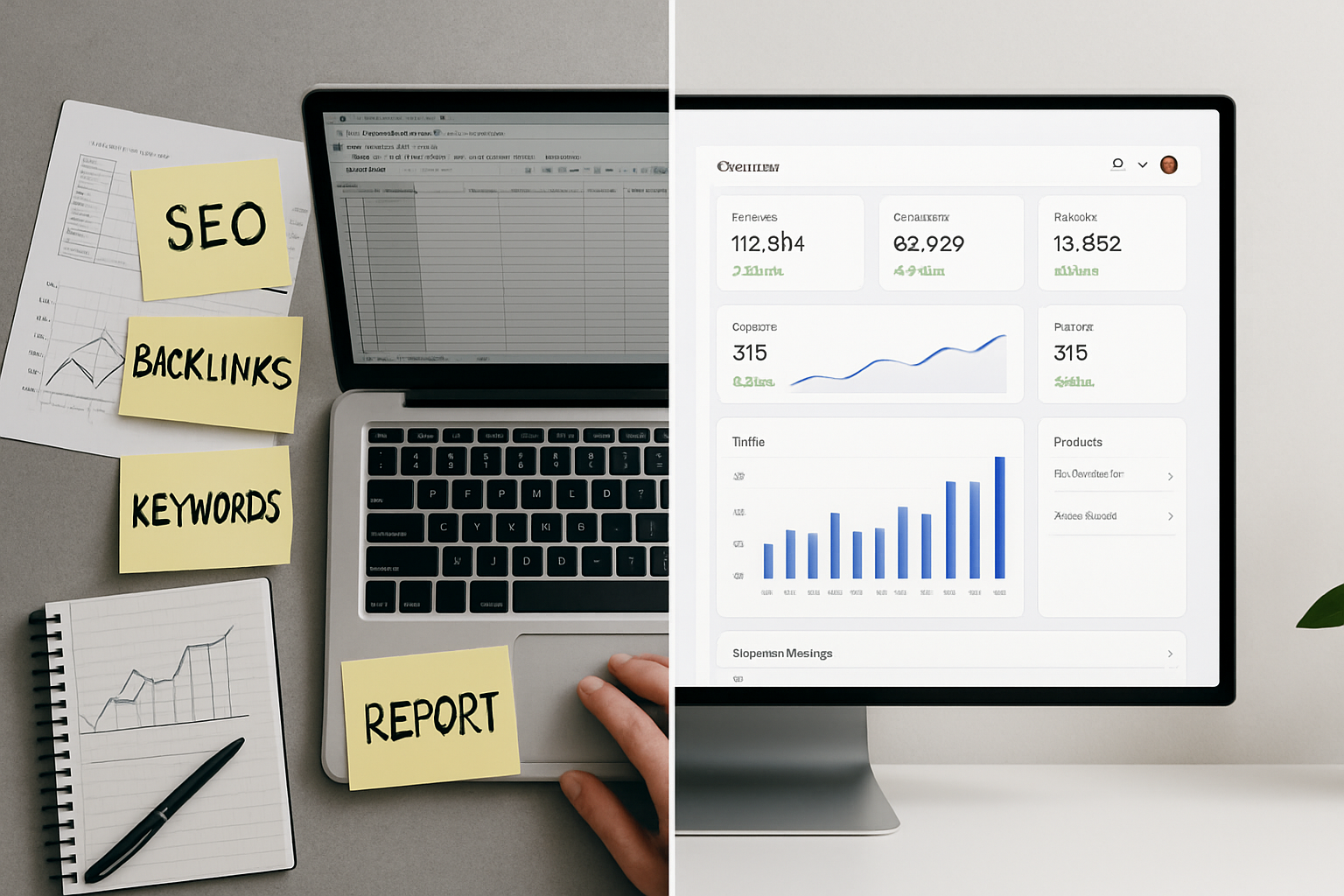
SEO analytics infrastructure is defined as the combination of data sources, dashboards, and reporting cadences that give your team a shared, accurate view of organic performance across all channels and campaigns. For growing teams, this means dashboards that update automatically, segment data by campaign or content type, and surface actionable insights rather than just raw numbers.
For teams looking to build out this infrastructure thoughtfully, exploring SEO analytics dashboard software designed to track, analyze, and grow your organic traffic provides a strong foundation for choosing the right reporting setup. The right dashboard eliminates the weekly reporting scramble and keeps every stakeholder aligned on progress.
Real-time visibility into which content is driving traffic, which pages are losing rankings, and which campaigns are outperforming expectations allows teams to make faster, better decisions. That speed of insight is one of the most underrated competitive advantages in SEO.
5. Role-Based Access and Team Workflow Management
Growing teams need SEO platforms that support multiple users with different roles and responsibilities. A content strategist, a technical SEO specialist, a paid search manager, and a department head all need access to SEO data — but they need different views and different permission levels. Role-based access is what makes that possible without creating security or data integrity risks.
Workflow management features — such as task assignment, approval queues, content status tracking, and deadline visibility — transform an SEO platform from a data tool into an operational hub. Teams that manage SEO workflows inside their analytics platform spend significantly less time in coordination meetings. That reclaimed time goes directly into output.
How Does AI Change the Scalability Equation for Marketing Teams?
AI fundamentally changes what’s possible for a marketing team of any size by automating the repetitive, time-consuming work that previously required hours of human effort. Keyword clustering, content briefs, competitive gap analysis, meta tag generation, and performance summaries — all of these can now be handled or accelerated by AI-powered features built directly into modern SEO platforms.
According to recent data from the content marketing industry, teams using AI-integrated SEO platforms produce content briefs 73% faster than teams using traditional tools, while maintaining or improving content quality scores. That productivity delta is enormous at scale — it’s the difference between publishing 10 pieces of content per month and publishing 30.
For teams operating across enterprise-level complexity, the case for AI-driven automation is even stronger. The detailed breakdown of how an AI-powered SEO platform is transforming the way businesses rank online explains how machine learning is now being applied to everything from crawl prioritization to predictive ranking models. These aren’t future capabilities — they’re available today.
What Should Growing Marketing Teams Look for When Choosing an SEO Platform?
The best way to evaluate a scalable SEO solution is to assess it against your team’s projected needs 12 to 18 months from now, not just your current situation. A platform that works well for a team of three may become a bottleneck for a team of twelve. Planning ahead prevents painful migrations mid-campaign.
Here are the key criteria to evaluate:
- Multi-user support with role-based permissions — Can different team members access the right data without seeing what they shouldn’t?
- Automated reporting and custom dashboards — Does the platform generate reports automatically and allow you to customize views by stakeholder?
- AI-assisted content optimization — Are AI features built into the core workflow, or bolted on as an afterthought?
- Technical SEO automation — Does the platform crawl your site continuously and alert you to critical issues in real time?
- Keyword clustering and topical mapping — Can the platform help you organize your keyword strategy around topic clusters, not just individual terms?
- Integration with your existing tech stack — Does it connect with your CMS, CRM, and analytics tools without requiring custom development?
- Onboarding and support quality — Will the vendor support you as your usage grows, or leave you to figure it out alone?
Teams evaluating their options should also read this thorough comparison of the best AI SEO software for digital marketers, covering top features, benefits, and how to choose the right platform. It provides a useful framework for making platform decisions that hold up under growth pressure.
How Can Teams Build a Scalable SEO Workflow From Scratch?
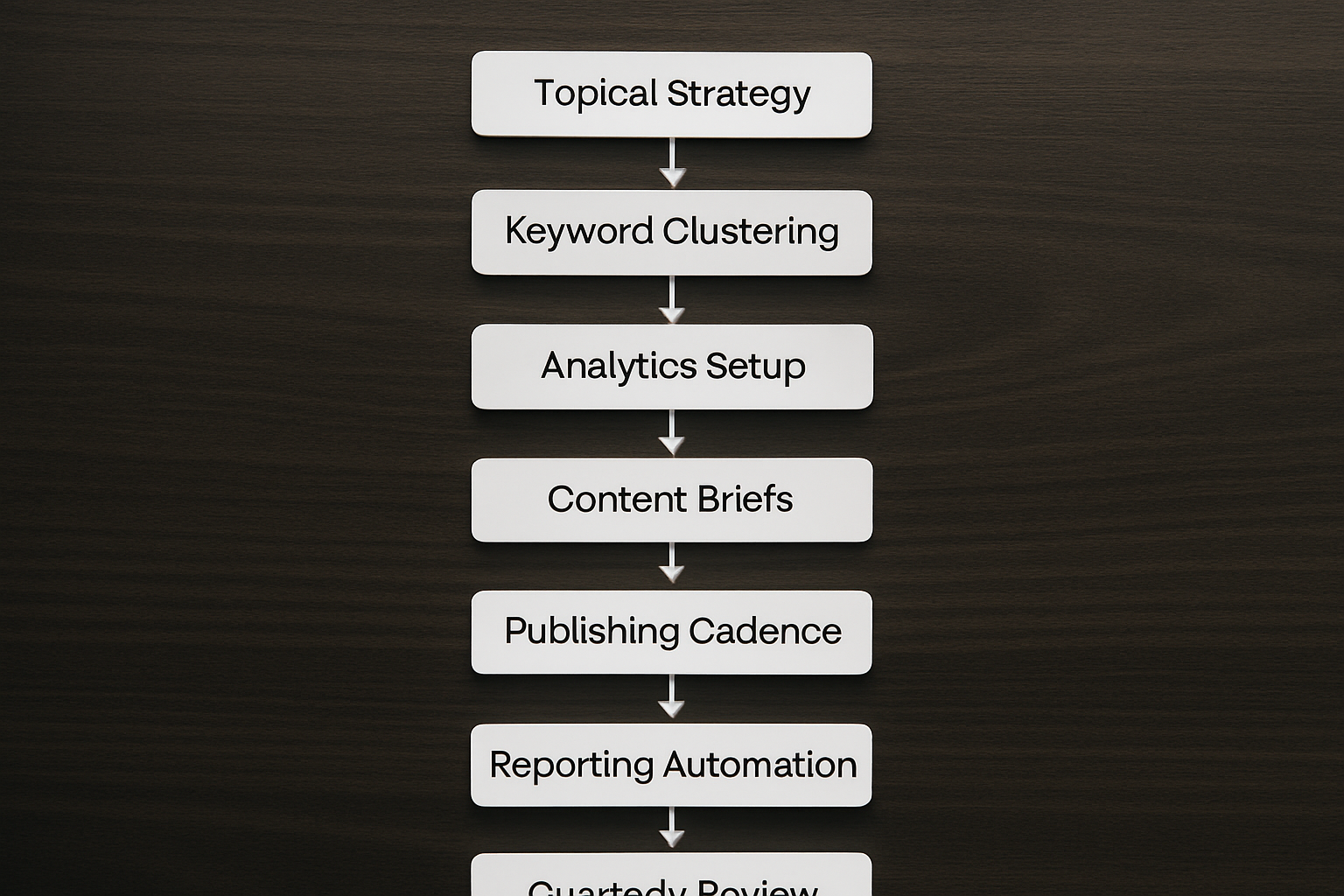
Building a scalable SEO workflow from scratch requires making decisions in a specific order: strategy before tools, structure before content, measurement before optimization. Teams that skip ahead to content production without a clear structural foundation end up with a large volume of under-performing content that’s expensive to fix retroactively.
Follow this sequence to build a strong foundation:
- Define your topical authority targets — Choose 5–10 core topic areas your brand will own in search, based on audience needs and business relevance.
- Build your keyword cluster map — For each topic area, identify a pillar keyword and 10–20 supporting long-tail keywords that address subtopics and questions.
- Set up your analytics infrastructure first — Before publishing a single piece of new content, ensure you have tracking, dashboards, and baseline metrics in place.
- Create content brief templates — Standardize how briefs are created so any writer on your team can produce on-strategy content without constant guidance.
- Establish a publishing and review cadence — Decide how frequently you publish, who reviews for SEO quality, and how optimization checks happen post-publish.
- Automate reporting and alerts — Configure your platform to surface ranking changes, traffic anomalies, and technical issues automatically rather than requiring manual checks.
- Review and iterate quarterly — Scalable systems aren’t set-and-forget. Build in a quarterly strategy review to assess what’s working and reprioritize accordingly.
Teams building toward enterprise-level SEO operations should also explore how large organizations structure their automation workflows in this guide to enterprise SEO automation platform SaaS and how to scale organic growth across large organizations. Many of the principles apply even to mid-sized teams preparing for rapid growth.
What Results Can Growing Teams Expect From a Scalable SEO Approach?
Teams that implement a properly structured scalable SEO solution typically see measurable improvements across three dimensions: output volume, ranking velocity, and team efficiency. According to industry benchmarks, marketing teams that centralize their SEO operations on a unified platform increase their content output by an average of 40% within the first six months. That increase compounds over time as processes become more familiar and efficient.
Ranking velocity — the speed at which new content begins appearing in search results and climbing toward page one — also improves significantly when content is built within a strategic cluster structure. Individual pieces benefit from the topical authority built by surrounding content, meaning newer pages rank faster than they would in isolation. This is one of the clearest arguments for cluster-based content strategy at scale.
Team efficiency gains are perhaps the most immediate benefit. When writers, strategists, and analysts all work within a shared system with clear workflows and automated reporting, coordination overhead drops sharply. Teams consistently report reclaiming 5–8 hours per week per team member when they move from fragmented legacy tools to a unified scalable platform — time that goes directly into higher-value strategic work.
Conclusion: Build Your SEO Foundation for Growth, Not Just for Today
A scalable SEO solution for growing marketing teams isn’t a luxury — it’s a strategic necessity for any organization that plans to grow its organic presence without proportionally growing its costs. The teams winning in search right now aren’t necessarily the ones with the biggest budgets. They’re the ones with the clearest systems, the most collaborative workflows, and the most intelligent use of automation and AI.
The steps outlined in this article — from topical clustering and content brief standardization to automated technical monitoring and unified analytics — represent a complete operational model for sustainable SEO growth. Each component reinforces the others, and the whole system becomes more effective the longer it runs.
If you’re ready to move beyond fragmented tools and manual processes, RankBloom SEO is built specifically for growing marketing teams that need a scalable, AI-powered SEO platform in a single unified workspace. From keyword research and content optimization to automated reporting and technical monitoring, RankBloom SEO brings everything your team needs into one place — so you can focus on growth instead of coordination. Start building your scalable SEO foundation with RankBloom SEO today.
Frequently Asked Questions
What is a scalable SEO solution for a marketing team?
A scalable SEO solution is a platform and workflow system designed to grow in capacity and efficiency alongside your team, enabling higher content output and better performance without requiring proportional increases in budget or headcount.
How many team members do you need before scalable SEO tools become necessary?
Even teams of two or three benefit from scalable systems, but the need becomes critical once you have four or more people contributing to SEO — at that point, tool fragmentation and process inconsistency start to create measurable performance drag.
What features should a scalable SEO platform include for growing teams?
A scalable SEO platform should include multi-user role-based access, automated technical monitoring, AI-assisted content optimization, unified keyword research, collaborative dashboards, and workflow management features that keep all team members aligned.
How does AI help marketing teams scale their SEO output?
AI accelerates the most time-consuming parts of SEO work — including keyword clustering, content brief creation, meta tag generation, and performance analysis — allowing teams to produce significantly more optimized content without adding headcount.
How long does it take to see results after implementing a scalable SEO strategy?
Most teams see measurable improvements in content output and team efficiency within the first 60 to 90 days, while ranking and traffic gains from a cluster-based content strategy typically become visible within three to six months of consistent publication.
Can a small marketing team benefit from the same scalable SEO tools used by large enterprises?
Yes — modern scalable SEO platforms are designed to serve teams at different growth stages, and starting with the right infrastructure early means small teams avoid the costly and disruptive migrations that come from outgrowing under-powered tools as they scale.