
Local SEO for Law Firms: Using AI Blog Content to Attract More Local Clients
Local SEO for law firms is one of the most powerful ways to connect your practice with clients actively searching for legal help in your area. In 2026, AI-generated blog content has become a central tool for law firms that want to dominate local search results without spending enormous budgets on traditional marketing. This article breaks down exactly how to combine local SEO strategies with AI content creation to grow your client base efficiently.
What Is Local SEO for Law Firms and Why Does It Matter?
Local SEO for law firms is defined as the process of optimizing a legal practice’s online presence so it appears prominently in location-based search results on Google and other search engines. This includes appearing in the Google Map Pack, local organic results, and voice search responses. It is specifically designed to attract clients who are searching for attorneys in a defined geographic area.
Studies show that 46% of all Google searches have local intent, meaning nearly half of everyone searching on Google is looking for something nearby. For law firms, this is critical because legal services are inherently local — clients want a lawyer they can meet in person. Ignoring local SEO means leaving a massive pipeline of potential clients completely untapped.
The stakes are even higher in 2026 because AI-powered search tools like Google’s AI Overviews now pull answers directly from local business content. If your law firm’s website doesn’t have well-structured, locally relevant content, your competitors will appear instead of you. Local SEO is no longer optional — it is the foundation of a competitive legal marketing strategy.
How Does AI Blog Content Help Law Firms Rank Locally?
AI blog content helps law firms rank locally by consistently producing relevant, keyword-rich articles that target specific geographic areas and legal practice areas. Search engines reward websites that publish fresh, helpful content regularly. AI tools allow law firms to maintain that publishing cadence without requiring attorneys to spend hours writing every week.
AI content generation is defined as the use of large language model technology to draft, outline, or enhance written articles, blog posts, and web pages based on prompts provided by a human editor. Tools like ChatGPT, Claude, and Jasper can generate full drafts of blog posts targeting keywords like “divorce attorney in Austin” or “DUI lawyer near Chicago.” These drafts are then reviewed and refined by legal professionals or marketing specialists before publishing.
A well-structured AI blog strategy for a law firm typically includes these content types:
- City-specific practice area pages (e.g., “Car Accident Lawyer in Phoenix”)
- Legal FAQ posts targeting questions local clients ask
- Case result summaries that demonstrate local expertise
- Local legal news commentary connecting current events to your practice areas
- Neighborhood and community-focused articles that build geographic relevance
Each of these content types signals to Google that your firm is authoritative, local, and relevant. Publishing two to four of these posts per month creates compounding SEO value over time. AI tools make this volume achievable even for solo practitioners or small firms.
Why Should Law Firms Prioritize Google Business Profile Alongside AI Content?
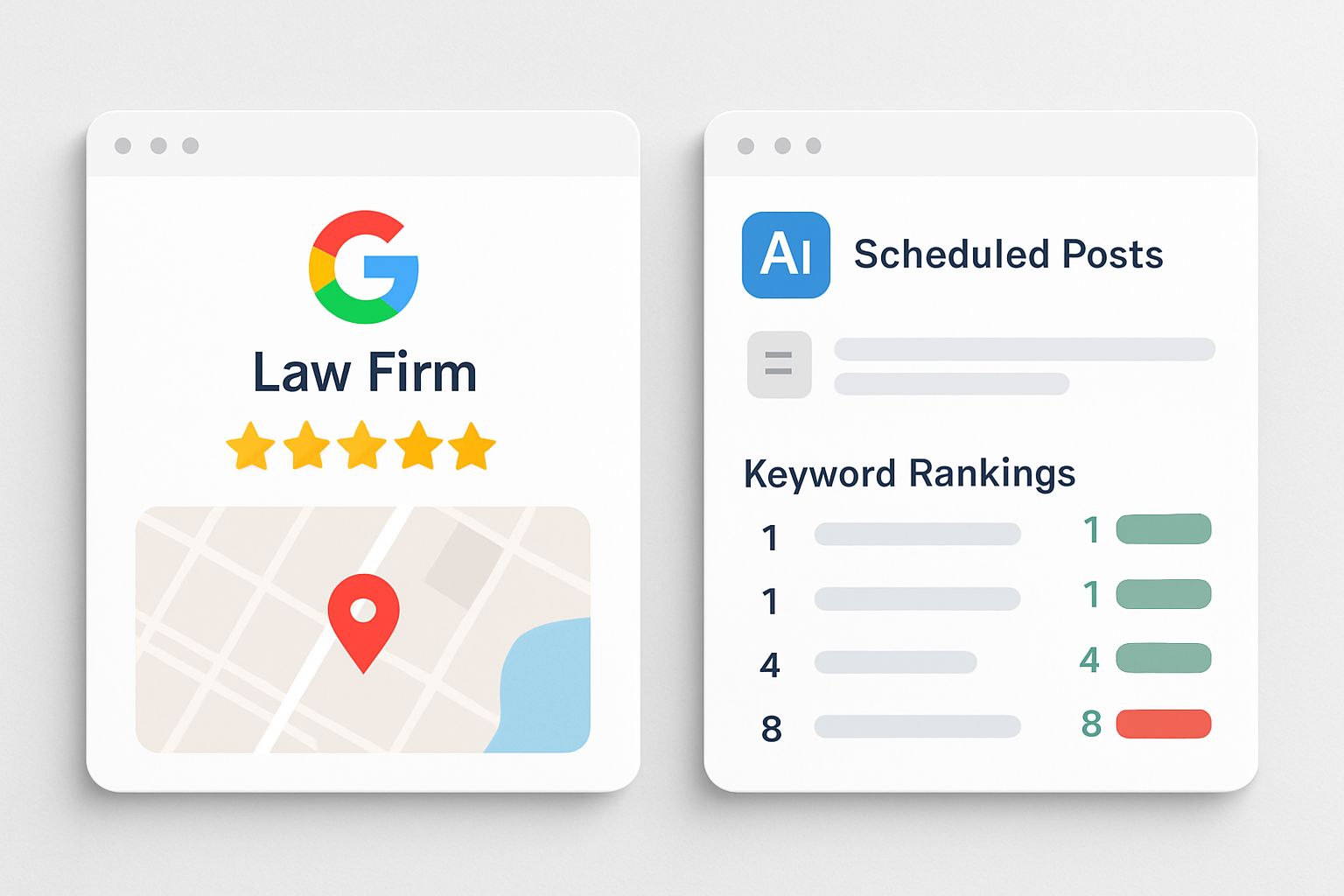
Google Business Profile (GBP) is the single most important local SEO asset a law firm can have. It controls whether your firm appears in the coveted Google Map Pack — the three-business listing that appears at the top of local search results. AI-generated blog content works in tandem with your GBP to build a complete local presence.
The best way to connect your AI content strategy to your GBP is to ensure that every blog post you publish links back to your firm’s main service pages and includes your city and state name naturally in the text. Google crawls your website and your GBP together as signals of local authority. Consistent name, address, and phone number (NAP) information across both platforms dramatically improves your local ranking signals.
According to a 2025 BrightLocal study, 87% of consumers used Google to evaluate local businesses, making it the dominant discovery platform for legal services. Law firms that actively post updates on their GBP and publish locally targeted blog content see significantly higher engagement from potential clients. Think of your GBP and your blog as two engines running in parallel — both need fuel to perform.
How Do You Create AI Blog Content That Feels Human and Builds Trust?
AI-generated content only works for law firm SEO when it feels authoritative, empathetic, and human. Potential clients dealing with legal issues are often stressed, frightened, or confused — they need to feel that a real expert understands their problem. Generic or robotic-sounding content will drive visitors away and damage your firm’s credibility.
The best way to humanize AI blog content for a law firm is to always add a layer of attorney review and personalization before publishing. This means inserting real case examples, local court references, attorney quotes, and specific city landmarks or regulations that only a local lawyer would know. This editorial layer transforms a solid AI draft into a genuinely trustworthy local resource.
Follow this five-step process for creating high-quality AI blog content for your law firm:
- Define the target keyword with local intent (e.g., “slip and fall attorney in Denver”)
- Prompt your AI tool with that keyword, your practice area, and your city
- Review the draft for legal accuracy and factual claims
- Add local specifics — mention local courts, laws, and community context
- Optimize on-page SEO — add meta descriptions, internal links, and schema markup
Schema markup is defined as structured data code added to a webpage that helps search engines understand the content and display it more prominently in search results, often as rich snippets or featured answers. For law firms, using LegalService schema and FAQPage schema on blog posts significantly increases the chance of appearing in AI-generated search overviews. This is a critical step that many law firm marketers still overlook in 2026.
What Keywords Should Law Firms Target in Their AI Blog Content?
Law firms should target a combination of high-intent transactional keywords and informational long-tail keywords in their AI blog content strategy. Transactional keywords signal that a user is ready to hire a lawyer, while informational keywords capture users earlier in their decision-making process. Both types are essential for a complete local SEO strategy.
High-performing local SEO keyword patterns for law firms include:
- Practice area + city: “estate planning lawyer in Nashville”
- Question + city: “how much does a divorce cost in Seattle”
- Problem + near me: “wrongful termination attorney near me”
- Specific legal situation + city: “what to do after a car accident in Miami”
- Competitor comparison + local: “best family law attorneys in Portland”
Research from Semrush in 2025 found that long-tail keywords with three or more words account for 70% of all legal search traffic. This means that very specific, locally focused questions — exactly the type AI tools can generate content for efficiently — represent the majority of how potential clients actually search. Targeting these long-tail phrases is far more cost-effective than competing for broad terms like “lawyer” or “attorney.”
How Can Small Law Firms Compete With Large Firms Using AI Content?
Small law firms can absolutely compete with large firms in local SEO by using AI content to publish at higher volumes and with greater geographic specificity than larger firms typically bother to pursue. Big law firms often target broad, high-competition keywords and neglect hyper-local neighborhood-level content. This creates a significant opportunity for smaller practices to own specific local niches.
A solo personal injury attorney in a mid-sized city, for example, can use AI to create blog posts targeting every major neighborhood, suburb, and nearby community in the metro area. Each post targets phrases like “car accident lawyer in [specific suburb]” with locally relevant details. Over six to twelve months, this strategy can build a library of local landing pages that collectively outperform a larger firm’s single generic city page.
The key competitive advantage for small firms is agility and specificity. Large firms have bureaucratic approval processes that slow down content publishing. Small firms using AI tools can respond to local legal news, seasonal trends, and community events with relevant blog posts within days. Speed and local relevance are the two areas where small firms can consistently win.
How Do You Measure the Success of AI Blog Content for Local SEO?
Measuring the success of local SEO for law firms using AI content requires tracking a specific set of performance metrics that connect content activity to client acquisition. Vanity metrics like total page views are far less useful than metrics that indicate actual local search performance. Focus your reporting on the numbers that reflect real business growth.
The most important metrics to track include:
- Google Business Profile views and clicks — direct local intent signals
- Organic traffic from local keyword searches — tracked via Google Search Console
- Keyword ranking improvements for targeted local terms
- Phone calls and contact form submissions attributed to organic traffic
- Map Pack appearance frequency for priority practice area keywords
Google Search Console is a free tool that shows exactly which search queries are driving traffic to your website, including local search terms. Reviewing this data monthly allows you to identify which AI blog topics are generating the most visibility and double down on similar content. Data-driven decisions are what separate law firms that grow through SEO from those that publish content without measurable results.
Frequently Asked Questions
Is AI-generated content safe to use for law firm websites?
Yes, AI-generated content is safe when it is reviewed by a qualified attorney before publishing to ensure legal accuracy and compliance. The key is treating AI as a drafting tool, not a final publisher — always add human editorial oversight.
How long does it take for AI blog content to improve local SEO rankings for a law firm?
Most law firms begin seeing measurable ranking improvements within three to six months of consistently publishing locally targeted AI blog content. SEO is a compounding strategy, so results accelerate the longer you maintain a consistent publishing schedule.
How many blog posts should a law firm publish per month using AI?
Publishing two to four well-optimized, locally targeted blog posts per month is an effective baseline for most law firms. Smaller firms new to SEO may see strong results even at two posts per month if the content is highly specific and well-structured.
Can AI content help a law firm appear in Google’s AI Overviews?
Yes, AI blog content structured with clear answers, FAQ sections, and schema markup significantly increases the likelihood of being cited in Google’s AI Overviews. Writing in a direct, question-and-answer format is the most effective approach for AI-generated search visibility.
Do I need to disclose that my law firm’s blog content was written with AI?
As of June 2026, there is no legal or Google requirement to disclose AI assistance in blog content for law firms. What matters is that the content is accurate, helpful, and reviewed by a licensed attorney — quality and compliance are far more important than the drafting method.
Start Using AI Blog Content to Build Your Law Firm’s Local Presence Today
Local SEO for law firms powered by AI blog content is one of the highest-return investments available to legal practices in 2026. It combines the speed and efficiency of AI with the trust-building power of genuinely helpful, locally relevant legal information. The firms that act on this strategy now will build a compounding SEO advantage that becomes increasingly difficult for competitors to overcome.
The best way to begin is to audit your current website content, identify the top five local keywords you want to rank for, and commission your first batch of AI-assisted blog posts targeting those terms. Start with your most profitable practice area and your primary city — then expand from there. Consistency and specificity are the two most powerful variables in your control.
If you are ready to take your law firm’s local visibility to the next level, start by integrating AI content creation into your monthly marketing workflow this week. Every week you wait is a week your competitors could be claiming the local search rankings that belong to your firm. The technology is accessible, the strategy is proven, and the opportunity is significant — now is the time to move.