
Improving your search engine ranking is one of the most valuable investments you can make for your website’s long-term growth. Higher rankings mean more visibility, more organic traffic, and ultimately more conversions — without paying for every single click. Whether you’re a beginner or someone who’s been working on SEO for a while, the strategies in this article will help you build a stronger, more sustainable presence in search results.

What Is Search Engine Ranking and Why Does It Matter?
Search engine ranking is defined as the position a web page occupies in a search engine results page (SERP) for a specific keyword or query. The higher your position, the more likely users are to find and visit your page. Ranking on the first page — ideally in the top three results — can mean the difference between steady organic traffic and digital invisibility.
Studies show that the first organic result on Google receives an average click-through rate of approximately 27.6%, while the tenth result receives less than 2.4%. That gap is enormous and highlights why ranking improvement should be a top priority. Even moving up a few positions can dramatically change how much traffic your site receives.
If you’re new to this topic, understanding the fundamentals is the right first step. Our guide on what SEO is and how search engine optimization works breaks down the core concepts in plain language, making it easy for anyone to grasp the basics before diving into advanced tactics.
How Do Search Engines Decide Which Pages Rank Higher?
Search engines use complex algorithms that evaluate hundreds of signals to determine which pages deserve the top spots. These signals include relevance to the user’s query, the authority and trustworthiness of the website, page experience metrics, and the quality of the content itself. Understanding how these factors interact is the foundation of any effective ranking strategy.
An algorithm is defined as a set of rules and calculations a search engine uses to evaluate web pages and determine their order in search results. Google’s algorithm, for example, updates thousands of times per year, with major core updates typically released several times annually. Each update refines how the engine interprets quality, intent, and relevance.
Three broad categories of ranking factors dominate most SEO conversations:
- On-page factors: Content quality, keyword usage, headings, meta tags, and internal linking
- Off-page factors: Backlinks, brand mentions, and social signals
- Technical factors: Site speed, mobile-friendliness, crawlability, and Core Web Vitals
Each of these categories requires its own set of actions and ongoing attention. Ignoring any one of them can create a ceiling that limits how high your pages can realistically rank.
Why Is Keyword Research the Starting Point for Better Rankings?
Keyword research is defined as the process of identifying the specific words and phrases your target audience types into search engines when looking for content, products, or services like yours. Without a clear understanding of which keywords to target, even excellent content can miss the mark entirely. Keyword research gives your SEO strategy direction and focus.
The best way to start keyword research is to think from your audience’s perspective, not your own. Ask yourself: what problem is my audience trying to solve, and how would they describe that problem in a search bar? This user-first approach leads to more relevant keyword targets that align with actual search behavior.
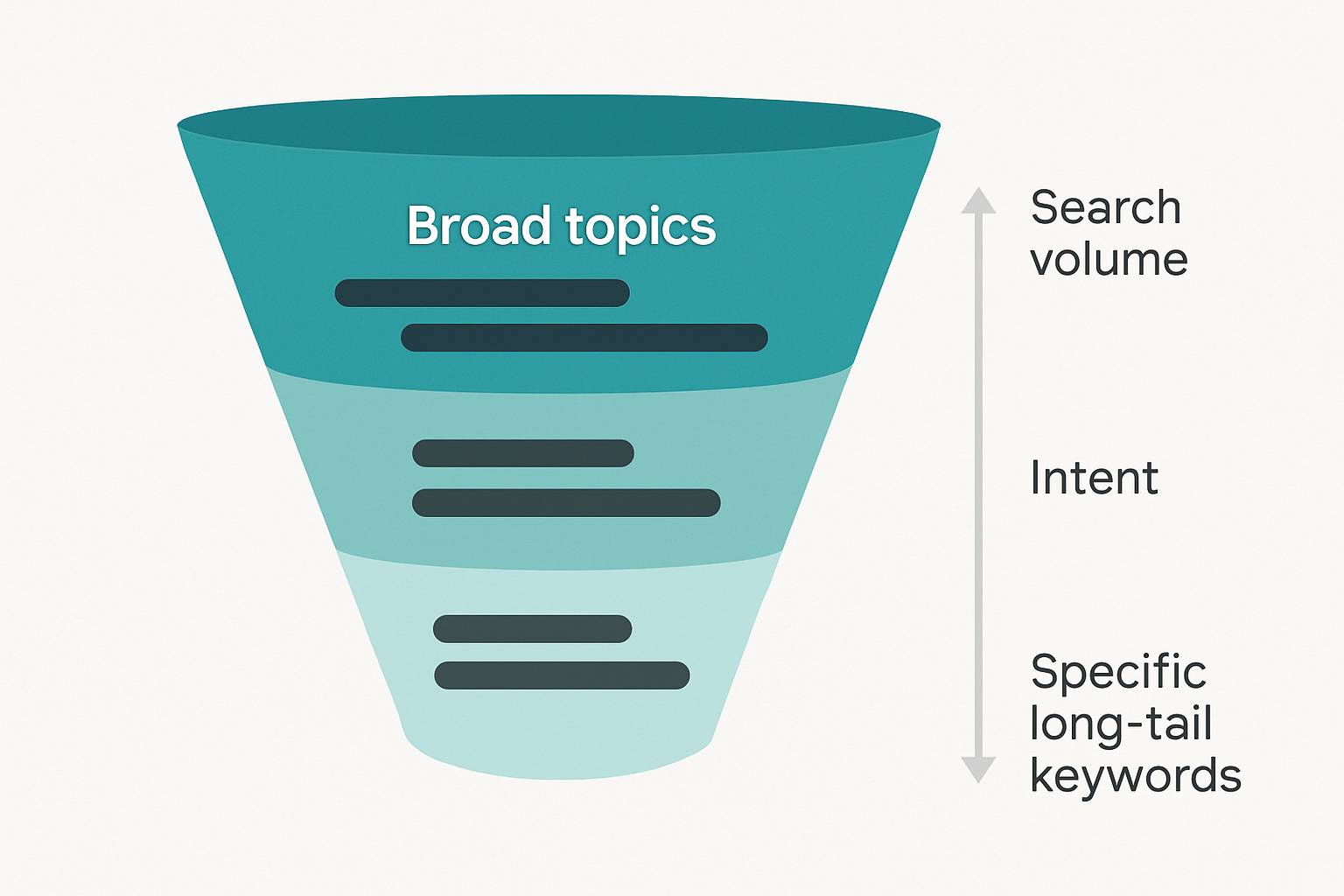
When evaluating keywords, consider three core metrics:
- Search volume: How many people search for this term each month
- Keyword difficulty: How competitive the term is based on existing ranking pages
- Search intent: Whether the query is informational, navigational, commercial, or transactional
Long-tail keywords — phrases that are three or more words — often have lower competition and higher conversion rates. A page targeting “how to improve search engine ranking for a local bakery” will compete with far fewer pages than one targeting just “SEO tips.” These specific, niche-focused terms are often where the smartest ranking wins happen.
How Does On-Page SEO Directly Improve Your Search Engine Ranking?
On-page SEO refers to all the optimizations you make directly on your web pages to make them more relevant and readable for both users and search engines. It’s one of the most controllable aspects of SEO because it depends entirely on decisions you make about your own content. Done well, on-page SEO signals to search engines exactly what your page is about and why it deserves to rank.
Start with your title tag and meta description. Your title tag should include your primary keyword naturally and be compelling enough to encourage clicks. Your meta description should summarize the page’s value in 150–160 characters, giving searchers a clear reason to choose your result over others.
Here are the essential on-page SEO elements to optimize:
- Title tag: Include the primary keyword near the beginning
- Meta description: Write a clear, benefit-focused summary with the keyword
- H1 heading: Use the keyword naturally and make the intent of the page clear
- H2 and H3 subheadings: Break content into digestible sections, using related keywords
- Body content: Write for humans first, integrating keywords naturally at ~1.5% density
- Image alt text: Describe images accurately and include keywords where relevant
- Internal links: Connect related content to distribute authority and improve navigation
- URL structure: Keep URLs short, descriptive, and keyword-inclusive
Content length also plays a role, though not in a simple “longer is better” way. Research from multiple content studies shows that pages ranking in the top three positions for competitive keywords average between 1,500 and 2,500 words. But the real driver is depth of coverage — thoroughly answering every aspect of a user’s query outperforms content that’s long but superficial.
Why Are Backlinks Still One of the Most Powerful Ranking Signals?
Backlinks are links from other websites pointing to your pages, and they remain one of Google’s most heavily weighted ranking factors even after decades of algorithm evolution. Each quality backlink acts as a vote of confidence from another site, signaling to search engines that your content is credible and worth referencing. The more authoritative the linking site, the more value that backlink carries.
Not all backlinks are equal, and this distinction matters enormously. A single link from a high-authority, relevant industry website carries far more ranking power than dozens of links from low-quality or unrelated sites. Quality over quantity is not just a cliché in backlink building — it’s a measurable reality backed by ranking data.
Proven strategies for earning high-quality backlinks include:
- Publishing original research, data, or statistics that others will naturally cite
- Creating comprehensive resource pages that serve as reference material in your industry
- Writing guest posts for reputable websites in your niche
- Building relationships with journalists and bloggers through genuine outreach
- Fixing broken links on relevant websites and offering your content as a replacement
- Producing shareable content like infographics, tools, or original studies
For those exploring actionable link-building and content strategies alongside budget-friendly tools, the guide on SEO tips for beginners that drive real organic traffic offers a practical starting point with step-by-step advice.
How Does Technical SEO Affect Your Ability to Rank Higher?
Technical SEO is defined as the process of optimizing the infrastructure of your website so that search engines can efficiently crawl, index, and understand your content. Even if your content is exceptional, technical issues can prevent search engines from properly accessing or interpreting your pages. Technical SEO is the foundation that every other ranking effort rests on.
Core Web Vitals are a set of performance metrics introduced by Google that measure real-world user experience, including loading speed, visual stability, and interactivity. As of 2026, these metrics continue to influence ranking decisions alongside content relevance. A slow, unstable website will struggle to compete — regardless of how good its content is.
Critical technical SEO factors to audit and fix include:
- Page speed: Aim for a Largest Contentful Paint (LCP) under 2.5 seconds
- Mobile responsiveness: Your site must perform flawlessly on all screen sizes
- HTTPS security: Secure websites are a confirmed ranking signal
- XML sitemap: Submit an updated sitemap to help search engines discover all your pages
- Robots.txt: Ensure you’re not accidentally blocking important pages from being crawled
- Canonical tags: Prevent duplicate content issues by specifying the preferred version of a page
- Structured data (Schema markup): Help search engines understand your content type for rich results
Running regular technical audits is essential because websites change constantly. New pages get added, old content gets moved, and plugins or updates can introduce errors that quietly damage your rankings over time.

How Does Content Strategy Compound Your Search Engine Ranking Growth?
Content strategy is more than publishing blog posts regularly — it’s about creating a deliberate, interconnected system of content that covers a topic comprehensively and builds topical authority over time. Search engines increasingly reward websites that demonstrate deep expertise across a subject area, not just individual pages that target isolated keywords. Building topical clusters is one of the most effective ways to accelerate ranking growth.
A topic cluster model consists of a central “pillar” page covering a broad topic in depth, supported by multiple “cluster” pages that explore specific subtopics in detail. Internal links connect the cluster pages back to the pillar page and to each other, distributing authority and reinforcing the site’s expertise on that subject. This structure signals to search engines that your site is a comprehensive resource, not just a collection of loosely related articles.
When planning your content, consistently ask these questions:
- What specific question is this piece of content answering?
- Does this content match the search intent of the target keyword?
- Is there existing content on this topic that I can update rather than create from scratch?
- How does this piece link to and support other content on my site?
- Am I covering this topic more thoroughly and helpfully than the current top-ranking pages?
Refreshing existing content is often underestimated as a ranking strategy. Studies show that updating and republishing older articles can increase organic traffic by up to 106% on average. Search engines favor content that is current, accurate, and regularly maintained over static content that never changes.
Why Is User Experience a Critical Factor in Modern Search Rankings?
User experience (UX) has become a direct ranking factor because search engines can now measure how users interact with your pages after clicking through from search results. High bounce rates, short dwell times, and quick returns to the search results all signal to Google that your page didn’t satisfy the user’s intent. Improving UX doesn’t just make users happier — it directly improves your ranking signals.
Key UX elements that influence rankings include clear page structure, fast load times, easy navigation, readable typography, and content that immediately delivers on the promise made in your title and meta description. If a user arrives at your page and can’t quickly find what they’re looking for, they’ll leave — and that behavioral signal will work against your rankings. Every UX improvement you make is simultaneously an SEO improvement.
Practical UX improvements to prioritize:
- Use clear, descriptive headings to help users scan content quickly
- Break up long text blocks with images, bullet points, and tables
- Ensure your call-to-action elements are visible and easy to interact with
- Minimize intrusive pop-ups that disrupt the reading experience
- Test your site on multiple devices and browsers regularly
How Can AI-Powered Tools Accelerate Your Ranking Improvement Efforts?
Artificial intelligence has transformed how SEO practitioners research, plan, and execute ranking strategies. Modern AI-powered platforms can analyze vast amounts of SERP data, identify content gaps, suggest keyword opportunities, and audit technical issues in a fraction of the time traditional approaches required. The right technology dramatically reduces the manual effort involved in achieving and maintaining strong rankings.
Traditional SEO tools often require significant learning curves, large subscription costs, and manual interpretation of complex data. Many legacy platforms were built for enterprise teams with dedicated analysts — not for solo entrepreneurs, small businesses, or growing startups working with limited budgets. The gap between what these tools offered and what smaller teams actually needed has created real demand for smarter, more accessible solutions.
If you’re looking to stretch your SEO budget further without sacrificing capability, our article on affordable SEO software for solo entrepreneurs and startups explores options that deliver real results without enterprise-level pricing.
What Is a Realistic Timeline for Seeing Search Engine Ranking Improvements?
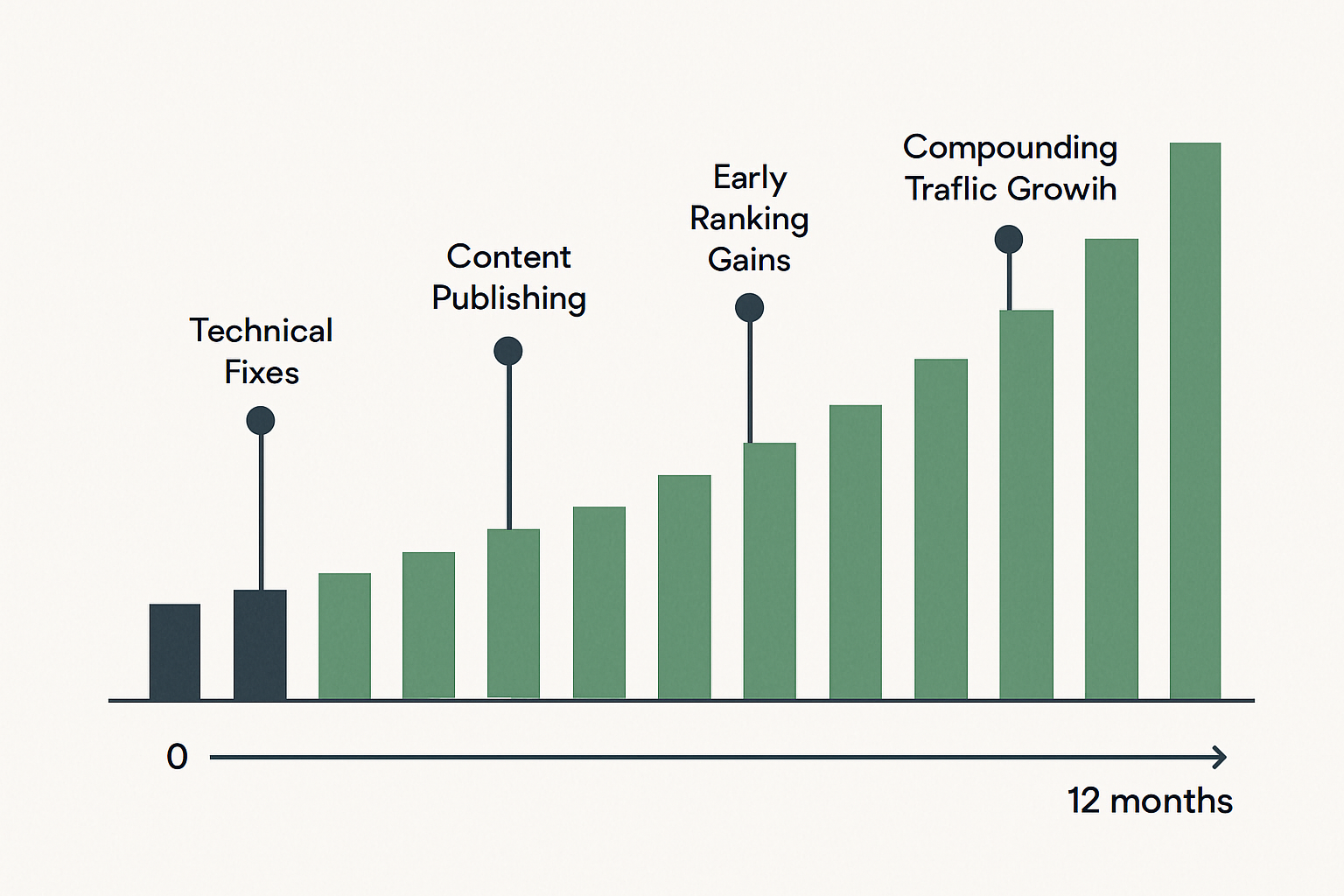
X is the most common question new SEO practitioners ask, and the honest answer is: ranking improvements take time, typically three to six months before significant results become visible. This timeline depends on the competitiveness of your target keywords, the age and authority of your domain, and the consistency of your optimization efforts. SEO is a compounding investment — the results grow faster the longer you maintain the strategy.
New websites on fresh domains face a longer initial period before rankings improve because they haven’t yet established authority or trust signals in the eyes of search engines. Established websites with existing authority can often see faster improvements simply by optimizing underperforming pages or fixing technical issues. Starting with lower-competition, long-tail keywords is the smartest approach for newer sites.
Setting realistic milestones helps keep teams motivated and strategy on track:
| Timeframe | Realistic Expectations |
|---|---|
| Months 1–2 | Technical fixes, content creation, initial indexing of new content |
| Months 3–4 | Early ranking movement for long-tail keywords, crawl improvements visible |
| Months 5–6 | Noticeable traffic growth, competitive keyword rankings beginning to improve |
| Months 6–12 | Compounding results, authority building, broader keyword coverage |
Consistency is the single most important factor in long-term ranking success. Sporadic efforts produce sporadic results — sustained, strategic action is what builds durable search visibility over time.
How Can You Track and Measure Your Search Engine Ranking Progress?
Tracking your ranking progress is essential for knowing whether your strategies are working and where adjustments need to be made. Without measurement, you’re operating without feedback — and that makes smart decision-making nearly impossible. The key metrics to monitor consistently are keyword rankings, organic traffic volume, click-through rates, and conversion rates from organic search.
Google Search Console is a free tool that provides direct data from Google on how your pages are performing in search results. It shows which keywords you’re ranking for, how many impressions and clicks each page receives, and alerts you to any technical issues that could be harming your visibility. It should be the first tool every website owner sets up before doing any other SEO work.
Beyond rankings, measure the quality of your organic traffic by tracking:
- Organic sessions (total visits from search engines)
- Pages per session (how much content users explore)
- Average session duration (how long users stay)
- Goal completions (sign-ups, purchases, form submissions driven by organic traffic)
Frequently Asked Questions
How long does it take to improve search engine ranking?
Most websites begin seeing meaningful ranking improvements within three to six months of implementing a consistent SEO strategy, though results vary based on competition, domain authority, and the quality of optimization efforts.
What is the most important factor for improving search engine ranking?
Content quality and relevance are consistently the most important factors, but technical SEO and backlink authority work alongside content to determine where a page ultimately ranks.
How many keywords should I target on a single page?
Each page should target one primary keyword and two to five closely related secondary keywords, all naturally integrated into the content without forcing repetition that disrupts readability.
Does social media activity help improve search engine ranking?
Social media does not directly influence search rankings, but it can amplify content reach, which increases the likelihood of earning backlinks and driving traffic signals that indirectly support ranking improvements.
How often should I update my website content to maintain rankings?
Reviewing and refreshing your key pages every three to six months is a strong practice, as updated content tends to perform better in rankings and ensures your information remains accurate and relevant to current search intent.
Can small businesses compete with large brands in search engine rankings?
Yes — by focusing on specific long-tail keywords, local SEO, and niche topical authority, small businesses can realistically outrank larger competitors in targeted areas where those brands have less focus or weaker content depth.
Start Improving Your Search Engine Ranking Today
Improving your search engine ranking is not a one-time task — it’s an ongoing process that rewards consistency, strategic thinking, and continuous learning. Every piece of content you optimize, every technical issue you fix, and every backlink you earn builds on the last, creating a compounding effect that grows stronger over time. The businesses that commit to this process are the ones that enjoy sustained organic visibility while their competitors continue paying for every click.
The strategies in this article — keyword research, on-page optimization, technical SEO, content strategy, link building, and user experience improvement — form a complete framework that works for websites at any stage of growth. Start with what’s most accessible given your current resources, and expand your efforts as results begin to compound. Small, consistent actions outperform large, sporadic campaigns every single time.
If you’re ready to put these strategies into action with smarter, AI-powered support, RankBloom SEO is built for exactly that. Unlike bloated traditional platforms that overwhelm users with unnecessary complexity, RankBloom SEO delivers the insights and tools you actually need to improve rankings — with clarity, efficiency, and results at the center of everything it does. Start your journey toward stronger search visibility with a platform designed to grow with you.