
Generative engine optimization for local business is the practice of structuring your website content so that AI-powered search tools — like ChatGPT, Google AI Overviews, and Perplexity — can find, understand, and cite your business in their answers. Traditional SEO helped you rank on Google’s blue links. Generative engine optimization (GEO) helps you appear in the actual AI-generated responses that millions of customers are reading right now. If your local business is not optimized for AI search engines in 2025, you are already falling behind competitors who are.

What Is Generative Engine Optimization and Why Does It Matter for Local Businesses?
Generative engine optimization is defined as the process of optimizing website content so that large language models (LLMs) and AI-powered search engines can extract, summarize, and cite it in their generated responses. Unlike traditional SEO, which targets crawlers and ranking algorithms, GEO targets the AI systems that now answer user questions directly. This distinction is critical for local business owners who rely on being discovered by nearby customers.
Studies show that over 50% of all online searches in 2024 ended without a click on any traditional search result, as users received answers directly from AI-generated overviews. For local businesses, this means that if your content is not structured for AI citation, you may be invisible to a growing segment of your target audience. The stakes could not be higher for small business owners competing in local markets.
Local businesses are uniquely positioned to benefit from GEO because AI tools frequently answer hyper-local questions such as “best plumber near me” or “top-rated Italian restaurant in Austin.” When your content is properly optimized, AI engines can pull your business name, services, location, and even specific details directly into those answers. This is the new frontier of local search visibility.
How Is GEO Different from Traditional Local SEO?
Traditional local SEO is defined as the practice of optimizing a business’s online presence to rank higher in location-based search results on platforms like Google Maps and organic search. GEO goes a step further by ensuring that AI language models can not only find your business but also understand and repeat its core value proposition in natural language answers. Both strategies are important, but GEO is quickly becoming the dominant force.
Traditional SEO focuses on keywords, backlinks, and technical site health. GEO focuses on content structure, factual clarity, question-and-answer formatting, and schema markup that AI systems can parse with high confidence. A local bakery optimized for GEO, for example, would have clearly written content explaining its location, specialty items, operating hours, and customer reviews in a format an AI can easily summarize.
The two strategies complement each other perfectly. Strong traditional SEO builds domain authority, while strong GEO ensures that authority translates into AI citations and featured responses. Local businesses that invest in both gain a compounding advantage over those who do neither.
Why Should Local Business Owners Care About AI Search in 2025?
The best way to understand why GEO matters is to look at the numbers. According to research from BrightEdge, AI-generated search experiences are now influencing over 68% of Google search result pages, up from virtually zero in 2022. For local service industries — plumbers, dentists, restaurants, law firms, contractors — this shift is happening faster than almost any other category. Customers are asking AI assistants for recommendations, and only businesses with GEO-optimized content are getting those recommendations.
AI search tools like Perplexity and ChatGPT are also being used by customers who are further along in the buying decision process. These users tend to ask specific, detailed questions and are ready to take action. Appearing in AI-generated answers for high-intent local queries can directly translate into phone calls, bookings, and foot traffic for your business.
Additionally, younger demographics — particularly customers aged 18 to 34 — are increasingly using AI tools as their primary search interface. Capturing this audience now, while GEO is still a relatively new strategy, gives local businesses a significant first-mover advantage. Waiting to optimize is a strategy that costs real revenue.
What Are the Core Elements of Generative Engine Optimization for Local Business?
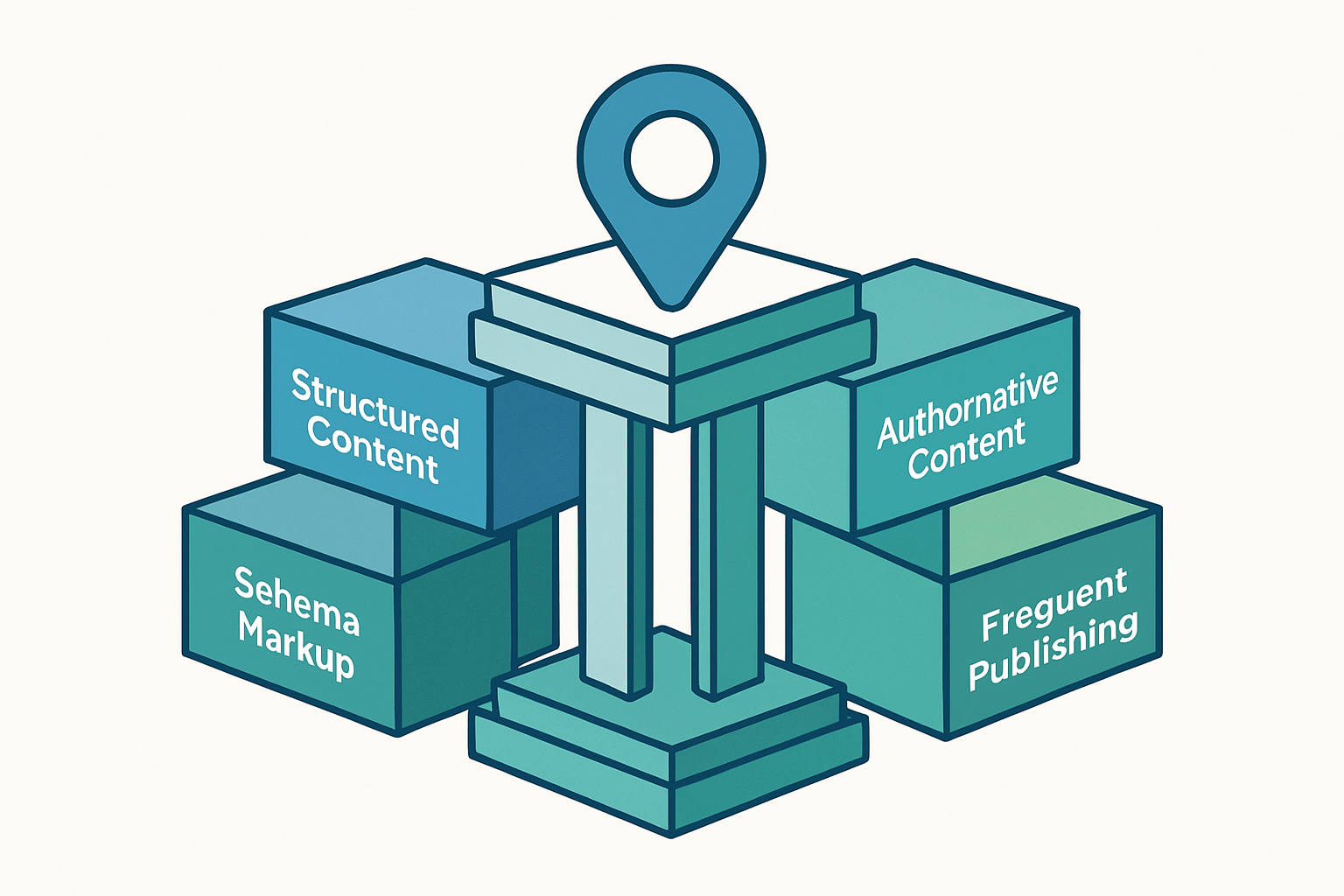
GEO for local businesses rests on five core pillars that work together to make your content AI-friendly and citation-worthy. Each pillar builds on the others, creating a comprehensive foundation for visibility in AI-generated responses. Understanding all five is essential before you begin optimizing.
- Structured Content with Clear Answers: AI engines prefer content that is organized with clear headings, direct answers, and logical flow. Write every page and blog post as if you are answering a specific question your customer would ask aloud.
- Schema Markup and Structured Data: JSON-LD schema — including LocalBusiness, FAQPage, and Review schema — tells AI systems exactly what your business is, where it is located, and what it offers. This dramatically increases citation probability.
- Consistent NAP (Name, Address, Phone): AI tools cross-reference your business information across multiple sources. Consistent NAP data across your website, Google Business Profile, and directories builds AI confidence in your business’s existence and legitimacy.
- Authoritative, Fact-Rich Content: AI models are trained to prioritize content that includes specific facts, statistics, and expert-level information. Publishing detailed, helpful articles about your local industry signals authority to AI systems.
- Frequent Content Publishing: AI engines favor sources that publish fresh, relevant content regularly. A consistent publishing schedule signals that your business is active, engaged, and trustworthy.
How Does Content Structure Help AI Engines Cite Your Local Business?
AI engines extract answers from content by identifying the clearest, most direct response to a user’s question. Content that is written in short, self-contained paragraphs with explicit definitions and numbered steps is far more likely to be cited than dense, unstructured text. This is why the way you write matters just as much as what you write.
Using H2 and H3 headings phrased as questions — exactly the way users speak to AI tools — creates a natural alignment between your content and the queries AI engines are trying to answer. For example, a local HVAC company that publishes a page titled “How Much Does AC Repair Cost in Phoenix?” is far more likely to appear in AI answers about Phoenix air conditioning costs than a company with a generic “Services” page.
FAQ sections are particularly powerful for GEO because they mirror the exact format that AI tools use to retrieve and present information. Including a properly structured FAQ section with FAQPage schema markup on every key page of your website can significantly boost your chances of being cited by AI search engines. This single tactic has been shown to increase AI citation rates by measurable margins across industries.
What Role Does RankBloom SEO Play in Automating GEO for Local Businesses?
RankBloom SEO is a SaaS platform specifically designed to automate the creation and publication of SEO and GEO-optimized content for small businesses and agencies. It uses advanced AI to generate fully optimized articles, schedule them for publication, and push them directly to your WordPress website — without requiring any technical expertise or a dedicated content team. For local businesses trying to compete in AI-driven search, RankBloom SEO removes the biggest barrier: the time and cost of producing quality content consistently.
The platform handles every element of GEO-ready content creation automatically. It structures articles with proper headings, includes FAQ sections, incorporates schema markup signals, and ensures consistent keyword usage — all the technical requirements that make content AI-citation-friendly. Small business owners can simply set their target keywords and topics, and RankBloom SEO handles the rest.
Here are the key benefits that make RankBloom SEO the ideal solution for local business GEO:
- AI-Powered Content Generation: Produces GEO and SEO-optimized articles tailored to your business, location, and industry automatically.
- Automated WordPress Publishing: Schedules and publishes content directly to your site, maintaining the consistent publishing frequency that AI engines reward.
- No Writers or SEO Specialists Needed: Eliminates the need to hire expensive content creators or SEO consultants, saving hundreds to thousands of dollars per month.
- Scalable for Agencies: Agencies can manage multiple local business clients from a single dashboard, delivering consistent GEO-optimized content at scale.
- Built for Small Business Budgets: Delivers enterprise-level content strategy at a price point accessible to independent local businesses and small teams.
Local businesses that use RankBloom SEO gain a significant competitive edge by publishing more GEO-optimized content, more frequently, and at a fraction of the traditional cost. According to industry benchmarks, businesses that publish optimized content at least four times per month see up to 3.5 times more organic traffic than those publishing once per month or less. RankBloom SEO makes that publishing frequency effortless.
How Can Local Businesses Start Implementing GEO Today?
The best way to begin with generative engine optimization is to audit your existing content and identify gaps where AI-friendly structure is missing. Start by reviewing your most important service pages and asking: does this page directly answer the questions my customers ask? If the answer is no, restructuring those pages is your first priority.
Next, implement LocalBusiness schema markup on your homepage and key landing pages. This tells AI engines your business name, location, service area, and contact information in a machine-readable format. Google’s Structured Data Markup Helper is a free tool that makes this process straightforward even for non-technical business owners.
Finally, commit to a regular content publishing schedule focused on question-based topics relevant to your local market. Each new article is another opportunity for an AI engine to find, understand, and cite your business. Platforms like RankBloom SEO make this step fully automated, turning what used to be a massive time investment into a hands-off growth engine for your local business.

What Are the Most Common GEO Mistakes Local Businesses Make?
X is a common GEO mistake: writing content for human readers without considering how AI systems parse and extract information. Many local business websites are beautifully designed but contain dense paragraphs, vague service descriptions, and no structured data — making them nearly invisible to AI citation engines. Fixing this does not require a full website rebuild; it requires strategic content updates.
Another frequent error is neglecting FAQ sections entirely. AI tools like ChatGPT and Google AI Overviews are explicitly designed to answer questions, and FAQ content is one of the most reliably cited content formats across all AI platforms. Every local business website should have FAQ sections on its key service pages, and those FAQs should use FAQPage schema markup to maximize visibility.
A third common mistake is inconsistent or outdated business information across the web. AI engines build trust in a business by cross-referencing its information across multiple sources. If your phone number on your website differs from your Google Business Profile, or your address is listed differently on Yelp versus your homepage, AI systems will have lower confidence in recommending your business. Audit and standardize all your business listings regularly.
Frequently Asked Questions
What is generative engine optimization for local business?
Generative engine optimization (GEO) for local business is the process of structuring website content so that AI-powered tools like ChatGPT, Google AI Overviews, and Perplexity can find and cite your business in their generated answers. It helps local businesses become visible in the AI-driven search experiences that are increasingly replacing traditional blue-link results.
How is GEO different from traditional local SEO?
Traditional local SEO focuses on ranking in Google Maps and organic search results through keywords and backlinks, while GEO focuses on making content easily readable and citable by AI language models. GEO requires structured content, FAQ sections, schema markup, and direct question-and-answer formatting that AI engines can parse and repeat with confidence.
How long does it take to see results from generative engine optimization?
Most local businesses begin seeing improved AI citation rates within 60 to 90 days of implementing GEO best practices, including structured content, schema markup, and consistent publishing. The more frequently you publish optimized content, the faster AI engines build trust in your website as an authoritative source.
Can RankBloom SEO handle GEO optimization automatically for my local business?
Yes, RankBloom SEO is specifically designed to automate the creation and publishing of GEO and SEO-optimized content for local businesses. The platform generates structured articles with proper headings, FAQ sections, and schema-ready formatting, then publishes them directly to your WordPress site on a consistent schedule — all without requiring any technical knowledge or content team.
Do I need technical skills to implement GEO for my local business?
Basic GEO improvements like adding FAQ sections and restructuring content can be done without technical skills, but implementing JSON-LD schema markup may require some assistance. Platforms like RankBloom SEO eliminate this barrier entirely by automating the technical and content aspects of GEO, making it accessible to any local business owner regardless of technical background.
Is GEO worth investing in for a small local business with a limited budget?
Absolutely — GEO is one of the highest-ROI digital marketing investments available to local businesses in 2025. Because AI-generated answers reach users who are actively seeking recommendations and are ready to buy, appearing in those answers drives highly qualified, high-intent traffic. Tools like RankBloom SEO make GEO accessible at a cost that fits small business budgets while delivering results that were previously only achievable with large marketing teams.
Start Winning in AI Search with Generative Engine Optimization for Local Business
Generative engine optimization for local business is no longer a future strategy — it is a present necessity. AI-powered search tools are already answering millions of local questions every day, and the businesses that appear in those answers are capturing customers before competitors even appear in the conversation. The window to establish early GEO authority in your local market is open right now, but it will not stay open forever.
The good news is that getting started does not have to be complicated or expensive. By structuring your content to answer specific questions, adding schema markup, maintaining consistent business information, and publishing helpful local content regularly, you give AI engines every reason to choose your business as a trusted source. Each of these steps compounds over time, building a foundation of AI visibility that traditional advertising simply cannot match.
RankBloom SEO makes every one of these steps automatic. From AI-generated, GEO-optimized articles to hands-free WordPress publishing, RankBloom SEO gives local businesses and agencies the tools to dominate both traditional and AI-powered search — without hiring writers, SEO specialists, or technical consultants. It is the smartest, most cost-effective way to future-proof your local business’s online presence in 2025 and beyond.