
Scaling SEO content production with artificial intelligence means using AI-powered tools and workflows to create, optimize, and publish high-quality, search-optimized content faster than traditional methods allow. For marketing teams, agencies, and solo creators alike, AI has fundamentally changed what’s possible — content that once took days to produce can now be drafted, refined, and published in hours. This shift is not about cutting corners; it’s about working smarter, focusing human creativity where it matters most, and letting intelligent automation handle the repetitive, time-consuming tasks.

Studies show that teams using AI-assisted content workflows produce up to 3x more content per month compared to those relying solely on manual processes. That productivity gain compounds over time, building topical authority faster and capturing more organic traffic at scale. The key is understanding how to integrate AI meaningfully — not just for speed, but for strategic depth and search relevance.
This article walks you through exactly how to scale SEO content production with artificial intelligence, covering the frameworks, best practices, and tools that make it work in the real world.
What Does It Actually Mean to Scale SEO Content with AI?
Scaling SEO content with AI is defined as systematically increasing your content output and quality by integrating artificial intelligence into every stage of the content lifecycle — from keyword research and topic clustering to drafting, optimization, and publishing. It is not simply using a chatbot to write blog posts. It is building a repeatable, intelligent system that amplifies your team’s capabilities.
Traditional content production has a hard ceiling determined by the number of writers and hours available. AI removes that ceiling by automating research, generating structured drafts, suggesting improvements, and flagging optimization gaps automatically. Teams of two or three people can now produce what previously required ten or more.
The best way to understand this is to map your current content workflow and identify where time is being lost. Most teams spend 60–70% of their time on research, briefing, and revisions — all areas where AI delivers immediate, measurable gains.
Why Is AI Content Production Different from Traditional SEO Writing?
AI content production is different because it combines natural language generation with real-time SEO data, enabling content that is simultaneously readable, relevant, and optimized for search engines from the first draft. Traditional SEO writing relied on a sequential process: research first, then write, then optimize. AI collapses those stages into a single, iterative loop.
Legacy platforms and manual workflows treat keyword research, content creation, and on-page optimization as separate activities. Modern AI-powered systems treat them as a unified process, generating content briefs, optimizing headings, suggesting semantic keywords, and scoring readability simultaneously. This integration is what makes scaling genuinely possible.
Another critical difference is consistency. Human writers, even excellent ones, produce variable results across briefs and topics. AI-assisted workflows apply the same optimization logic to every piece, ensuring a consistent quality baseline across your entire content library.
How Does AI-Powered Keyword Research Unlock Content Scale?
AI-powered keyword research is defined as the use of machine learning algorithms to analyze search data, identify content gaps, and group related queries into topical clusters automatically — far faster than manual research allows. A human researcher might identify 20–30 keyword opportunities per hour. An AI system can surface hundreds of clustered, intent-mapped opportunities in minutes.
The real power lies in topical clustering. Rather than targeting individual keywords in isolation, AI groups semantically related queries into content hubs, allowing you to build comprehensive topic authority with a structured series of articles instead of disconnected posts. This approach aligns directly with how modern search engines evaluate topical depth and expertise.
Research from content marketing analysts in 2026 indicates that websites using AI-driven topic cluster strategies see an average 47% improvement in organic visibility within six months of implementation. That result is driven not by volume alone but by the strategic interconnectedness of AI-organized content.
How Should You Build a Topic Cluster with AI?
- Identify your pillar topic — choose a broad subject central to your business or niche.
- Use AI to map supporting subtopics — generate a list of related queries, questions, and semantic variations.
- Group by search intent — separate informational, navigational, and transactional queries.
- Assign content types — long-form guides for pillar pages, shorter focused posts for cluster articles.
- Plan internal linking — map how cluster articles will link back to the pillar and to each other.
This structured approach transforms keyword research from a one-off task into a scalable strategic asset. Every cluster you build adds compounding SEO value over time.
What Is the Right AI Content Workflow for High-Volume Production?
The right AI content workflow for high-volume production is a structured, repeatable system that moves each piece of content through clearly defined stages: brief generation, AI-assisted drafting, human editorial review, on-page optimization, and publishing. Skipping any stage — especially the human review step — risks producing content that ranks poorly or fails to convert.
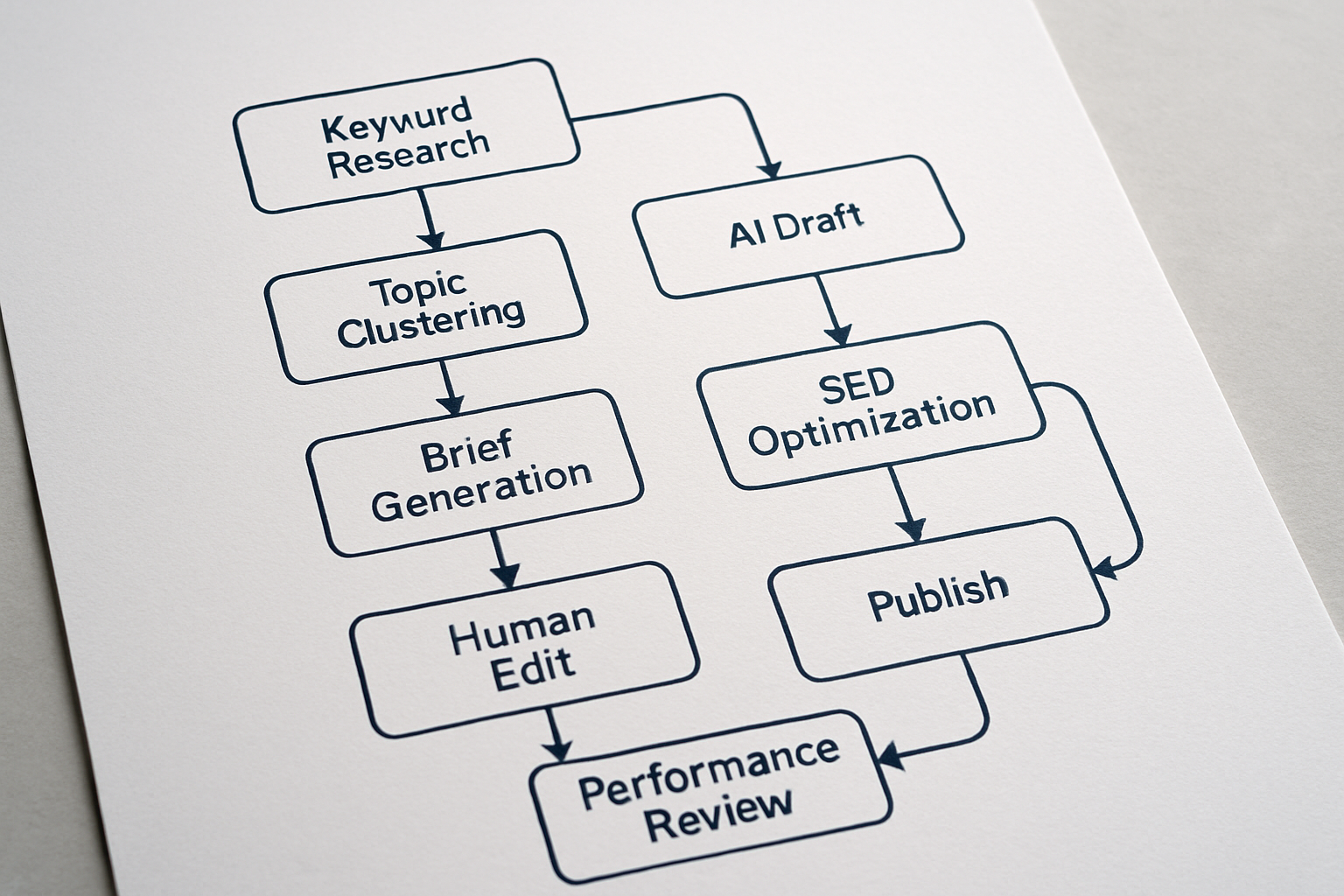
The most effective teams treat AI as a co-writer, not a replacement writer. AI handles structure, keyword integration, and first-draft generation. Human editors add voice, nuance, expert insight, and factual accuracy. This collaboration consistently outperforms purely human or purely AI approaches in both quality and speed.
Here is what a practical high-volume AI content workflow looks like in action:
- Brief generation: AI analyzes the target keyword and produces a structured brief including recommended headings, semantic keywords, and word count targets.
- Draft creation: AI generates a first draft aligned to the brief, incorporating relevant data points and optimized subheadings.
- Human editorial pass: An editor adds brand voice, expert commentary, and checks all factual claims for accuracy.
- On-page SEO scoring: AI tools evaluate keyword density, heading structure, meta tags, internal linking, and readability.
- Final publish and index: Content is published and submitted for indexing, with performance tracking activated from day one.
This workflow can produce four to eight fully optimized articles per day per writer-editor team, compared to one or two using traditional methods alone. The leverage AI provides is not theoretical — it is measurable and immediate.
How Does AI Improve On-Page SEO Optimization at Scale?
AI improves on-page SEO optimization by automatically analyzing content against hundreds of ranking signals — including keyword placement, semantic relevance, heading hierarchy, readability scores, and internal link distribution — and providing actionable recommendations in real time. Manual on-page auditing is slow and inconsistent. AI makes it instant and standardized.
On-page SEO optimization is defined as the process of adjusting visible and non-visible elements of a webpage — such as title tags, headings, meta descriptions, image alt text, and body copy — to improve its relevance and ranking potential for target search queries. AI tools now handle much of this automatically, flagging gaps before content is even published.
For content teams publishing at scale, this is transformative. Instead of auditing 100 articles manually after publication, AI continuously monitors your content library and surfaces optimization opportunities across every piece simultaneously. For a deeper look at finding the right tools for this process, explore this guide on the SEO content generation tool that helps you create high-ranking content faster and smarter.
What On-Page Elements Should AI Optimize First?
When prioritizing on-page optimization with AI, focus on the highest-impact elements first. These typically include:
- Title tags and meta descriptions — directly affect click-through rates from search results.
- H1 and H2 headings — signal content structure and primary topic relevance to search engines.
- Semantic keyword coverage — ensures content addresses related terms that search engines associate with the primary query.
- Internal linking — distributes page authority and helps search engines understand content relationships.
- Content length and depth — AI benchmarks your content against top-ranking competitors to identify gaps.
Why Is Human Oversight Still Essential When Scaling AI Content?
Human oversight is still essential because AI-generated content, while impressively capable, lacks lived experience, genuine expertise, and contextual judgment — qualities that both readers and modern search engines now actively evaluate. Google’s quality guidelines and AI-detection-aware ranking systems in 2026 specifically reward content that demonstrates authentic expertise, authority, and trustworthiness (E-E-A-T).
Studies show that purely AI-generated content without human editing has a 28% higher rate of factual inaccuracies than human-reviewed drafts. That risk is unacceptable for brands building long-term organic authority. AI accelerates the process; humans ensure the outcome is trustworthy and valuable.
The most successful content teams at scale operate with a 70/30 model: approximately 70% of the workflow is AI-automated, and 30% involves skilled human input focused on accuracy, brand voice, and strategic insight. This balance produces content that ranks well and genuinely serves the reader.
How Do You Measure the Success of an AI-Powered Content Program?
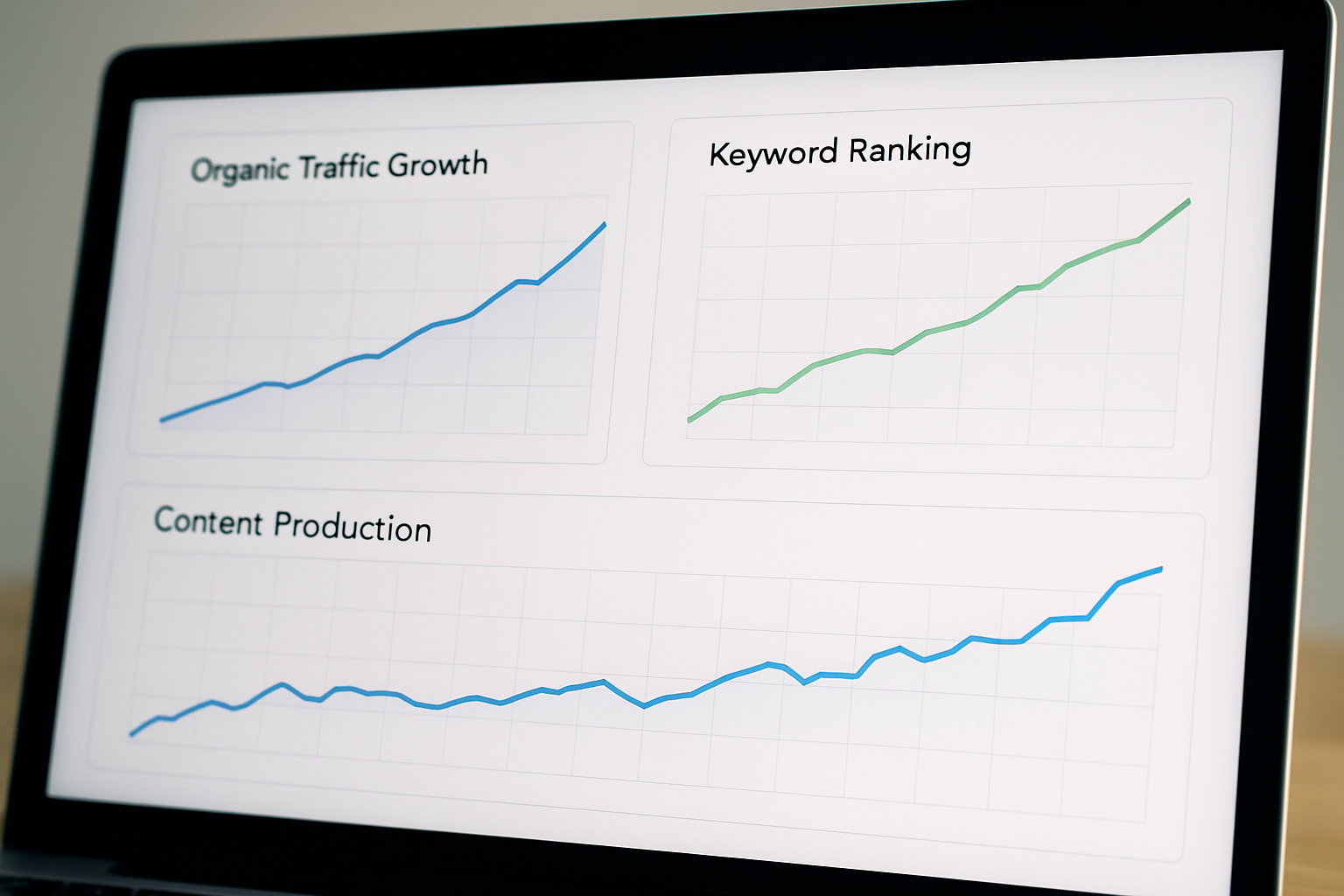
The best way to measure the success of an AI-powered content program is to track a combination of production efficiency metrics and SEO performance metrics simultaneously, giving you a complete picture of both output volume and organic impact. Output volume without organic results is vanity; rankings without production efficiency is unsustainable.
Key performance indicators to monitor include:
- Articles published per month — baseline productivity benchmark.
- Average time per article — measures efficiency gains from AI adoption.
- Organic impressions and clicks — direct measure of search visibility impact.
- Keyword ranking improvements — tracks position changes for target queries.
- Organic traffic growth rate — month-over-month and quarter-over-quarter trends.
- Content ROI — revenue or leads attributable to organic content channels.
Consistent performance tracking also reveals which content types and topic clusters are delivering the strongest returns, allowing you to direct AI resources toward the highest-value opportunities. For a comprehensive approach to understanding your search data, read this detailed breakdown of building an SEO performance analytics dashboard that helps you track, interpret, and act on your search data.
What Common Mistakes Should You Avoid When Scaling AI Content?
The most damaging mistakes when scaling AI content fall into three categories: over-automation, under-optimization, and poor strategic alignment. Each one can cancel out the productivity gains AI provides and actually harm your organic rankings if left unchecked.
Here are the most common pitfalls and how to avoid them:
- Publishing AI drafts without editorial review — always apply a human editing pass to ensure accuracy, voice, and factual integrity.
- Producing volume without strategy — every piece should map to a keyword target, user intent, and content cluster. Random output does not build authority.
- Ignoring E-E-A-T signals — add author bylines, expert quotes, original data, and real-world examples to demonstrate genuine expertise.
- Neglecting content updates — AI makes it easy to identify and refresh outdated content, which often delivers faster ranking gains than publishing new pieces.
- Failing to track performance — without measurement, you cannot optimize your AI workflow or content investment over time.
Avoiding these mistakes is the difference between AI content production that becomes a sustainable competitive advantage and AI content that creates a liability of low-quality, duplicate-risk pages.
How Can Small Businesses and Agencies Both Benefit from AI Content Scaling?
AI content scaling benefits small businesses by giving them the content production capacity of a much larger team, and it benefits agencies by allowing them to service more clients without proportionally growing their headcount. The leverage is meaningful at both ends of the market.
For small businesses, the priority is efficiency — producing enough high-quality content to compete for organic traffic without a large editorial budget. For a practical overview of tools built for this context, this resource on the best AI-powered SEO software for small business owners covers smart tools that drive real results without enterprise-level complexity.
For agencies, the priority is scalability and consistency across multiple client accounts. AI enables standardized content quality, faster delivery timelines, and more comprehensive keyword coverage — all of which translate directly into stronger client retention and higher margins.
What Should Agencies Look for in an AI SEO Content Platform?
Agencies need platforms that support multi-client account management, team collaboration features, and automated reporting. They also need robust content brief generation and keyword research capabilities that can be customized per client niche and target audience.
Integration with publishing platforms, scalable pricing that grows with client volume, and transparent performance dashboards are also non-negotiable for agency workflows. The right platform acts as the operational backbone of the entire content production system.
—
Frequently Asked Questions
Frequently Asked Questions
How much content can a team realistically produce using AI SEO tools?
A small team of two to three people using a well-structured AI content workflow can realistically produce 20 to 40 fully optimized articles per month — compared to five to ten using manual methods alone. The exact output depends on article length, niche complexity, and the depth of human editorial review applied.
Does AI-generated content rank well on Google?
AI-assisted content — meaning AI-drafted and human-edited content — ranks well when it genuinely addresses search intent, demonstrates expertise, and meets on-page SEO best practices. Purely machine-generated content published without editorial oversight tends to underperform due to thin quality signals and E-E-A-T deficiencies.
Is it safe to use AI for all types of SEO content?
AI works well for informational blog posts, how-to guides, product descriptions, and FAQ pages. It requires more careful human oversight for highly technical content, medical or legal topics, and any content where accuracy and authoritative expertise are critical ranking factors.
How long does it take to see results from an AI-powered content strategy?
Most teams begin to see measurable organic traffic improvements within three to six months of implementing a structured AI content strategy. Topic cluster-based approaches — where multiple related articles are published together — tend to accelerate results by building topical authority faster.
Do I need technical skills to implement an AI SEO content workflow?
No advanced technical skills are required. Most modern AI SEO platforms are designed with intuitive interfaces that guide users through keyword research, brief creation, content drafting, and optimization without requiring coding or deep technical SEO expertise.
—
Start Scaling Your SEO Content Production Today
Scaling SEO content production with artificial intelligence is no longer a futuristic ambition — it is a practical, proven approach that teams of all sizes are using right now to grow organic traffic faster, more efficiently, and more sustainably than traditional methods allow. The framework is clear: combine strategic keyword research, AI-assisted drafting, human editorial judgment, and consistent performance tracking into a repeatable workflow.
The teams winning in organic search in 2026 are not the ones with the biggest budgets — they are the ones with the smartest systems. AI gives you the leverage to compete at a higher level regardless of team size or content budget.
RankBloom SEO is built specifically to help you implement exactly this kind of intelligent, scalable content system. From AI-powered keyword research and automated content briefs to on-page optimization scoring and performance analytics, RankBloom SEO brings every stage of your content workflow into one unified, modern platform — so you can focus less on manual tasks and more on growing your organic presence. If you are ready to scale smarter, RankBloom SEO is the place to start.