
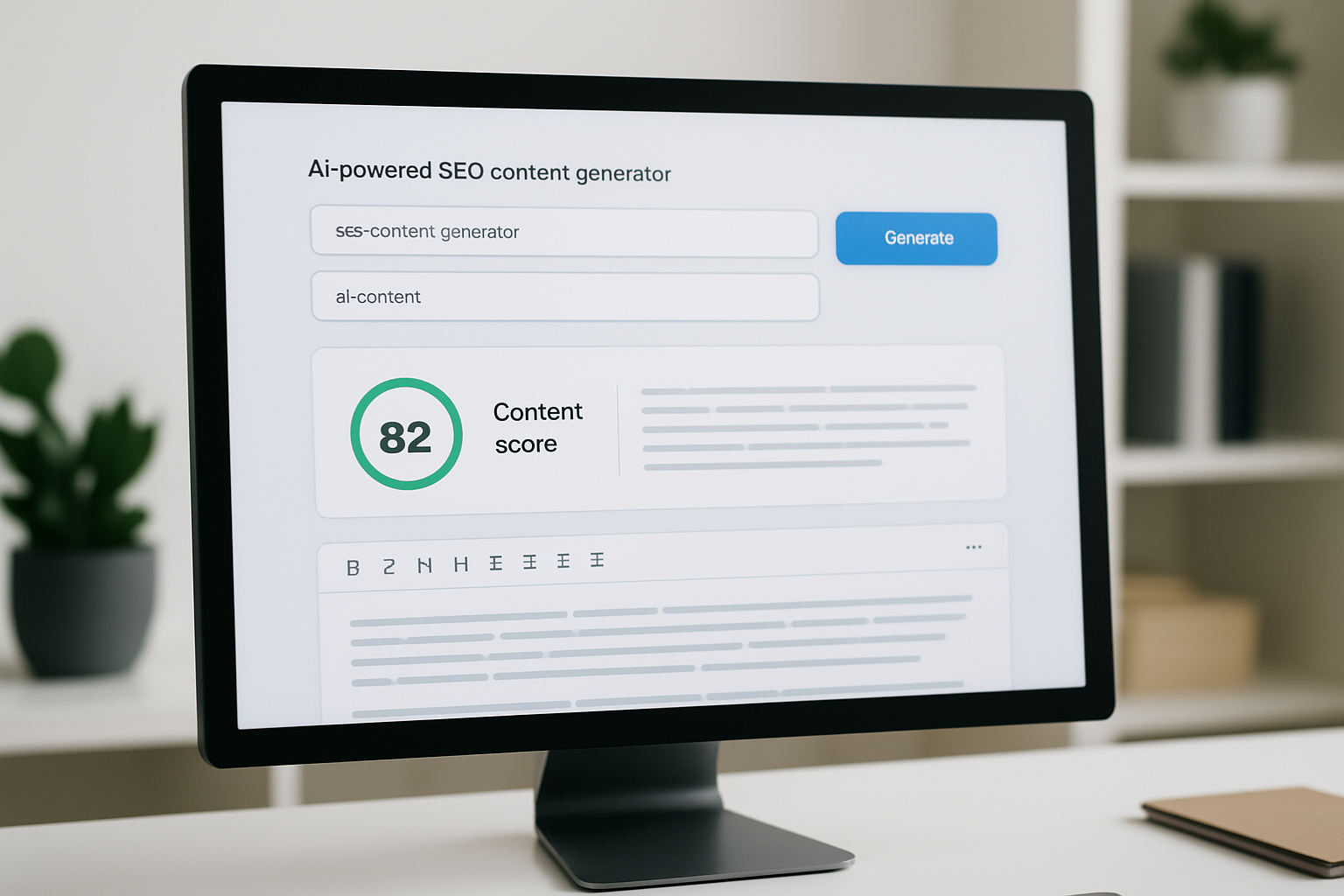
An SEO content generator is a software tool that uses artificial intelligence to produce written content optimized for search engines. These tools analyze keyword data, search intent, and competitor content to create articles, blog posts, and web copy that are designed to rank on Google. In a world where publishing speed and content quality both matter, these tools have become essential for modern content strategies.
According to a 2026 Content Marketing Institute report, 73% of marketers now use some form of AI assistance in their content creation process. The demand for high-quality, search-optimized content has never been higher. Businesses that fail to publish consistently risk losing organic traffic to competitors who do.
Studies show that websites publishing at least four optimized blog posts per week receive 3.5 times more organic traffic than those publishing once a week or less. An SEO content generator bridges the gap between the need for volume and the reality of limited time and resources. This article explains exactly how these tools work, what features matter most, and how to use them effectively.
What Is an SEO Content Generator and How Does It Actually Work?
An SEO content generator is defined as an AI-powered tool that automates the creation of search-engine-optimized written content based on target keywords, topic clusters, and competitive analysis data. It combines natural language processing (NLP) with real-time SERP data to produce content that is both readable and algorithmically relevant. Most modern generators handle everything from keyword placement to heading structure and meta descriptions.
The core process typically works in three stages. First, the tool analyzes the top-ranking pages for your target keyword to understand what Google already considers authoritative. Second, it generates a content outline or full draft based on that analysis. Third, it scores or edits the content for keyword density, readability, and semantic relevance.
Under the hood, these tools rely on large language models (LLMs) trained on billions of web pages. Natural language processing (NLP) is defined as a branch of artificial intelligence that enables computers to understand, interpret, and generate human language in a meaningful way. When applied to SEO, NLP helps generators identify semantically related terms, answer user questions naturally, and match the tone of top-ranking content.
Why Are SEO Content Generators Becoming Essential for Modern Businesses?
The primary reason businesses adopt an SEO content generator is the dramatic reduction in time-to-publish. Writing a well-researched, optimized 2,000-word article manually can take a skilled writer four to six hours. An AI generator can produce a comparable first draft in under five minutes, freeing up writers to focus on editing, strategy, and subject-matter expertise.
Beyond speed, these tools solve a consistency problem. Human writers naturally vary in how they approach keyword usage, heading structure, and meta data. An SEO content generator applies the same optimization rules to every piece of content, ensuring nothing is accidentally missed. Consistency in optimization is one of the most underrated factors in long-term organic growth.
If you’re just getting started with SEO, understanding the foundational principles first will help you get more out of any content tool. Our guide on essential SEO tips for beginners and how to start ranking your website on Google is a great place to build that foundation before you dive into automation.
How Does an SEO Content Generator Differ from Traditional Content Tools?
Traditional SEO tools were built primarily for analysis, not creation. They could tell you what keywords to target, how difficult they were to rank for, and how your competitors performed. The actual writing was always left entirely to the human.
Modern SEO content generators close that loop. They take the analytical intelligence that used to live in separate platforms and combine it with generative AI in a single workflow. You input a keyword, and the tool handles research, outlining, drafting, and optimization simultaneously.
Legacy platforms also require significant training and experience to use effectively. A skilled SEO professional might spend months learning how to interpret data from traditional tools. An AI content generator, by contrast, is designed for usability — marketers, founders, and content managers without deep technical SEO knowledge can produce optimized content from day one.

What Features Should You Look for in a Strong SEO Content Generator?
Not all SEO content generators are built equally. Choosing the wrong one can result in thin, repetitive content that actually hurts your rankings rather than helping them. Here are the most important features to evaluate before committing to any platform.
Keyword Integration and Semantic Coverage
A strong generator should place your primary keyword naturally throughout the content and automatically include semantically related terms. Semantic SEO is defined as the practice of optimizing content to cover the full range of related concepts around a topic, rather than repeating a single keyword. Google’s algorithms now reward topical depth over exact-match keyword stuffing.
Look for tools that show you which semantic keywords are missing from your content in real time. The best generators give you a topical coverage score alongside your draft. This ensures your content satisfies the full search intent behind a query, not just the surface-level keyword.
SERP Analysis and Competitor Content Benchmarking
A good SEO content generator pulls live data from Google’s top results before generating your content. This means it knows what word count, heading structure, and subtopics are already performing well for your target keyword. Generating content without this context is like writing a proposal without knowing what the client already wants.
Competitor benchmarking features also show you content gaps — topics your competitors cover that you haven’t addressed yet. Filling these gaps systematically is one of the fastest ways to build topical authority in your niche. Authority is now a key ranking signal in Google’s Helpful Content framework.
Readability and Tone Controls
Content that ranks but isn’t readable will have high bounce rates, which signals poor quality to Google. The best generators let you control reading level, tone of voice, and formatting preferences. These controls ensure the output matches your brand voice and audience expectations, not just a generic AI style.
Built-In Optimization Scoring
Real-time content scoring gives you an objective measure of how well your content is optimized before you publish. Scores typically evaluate keyword density, heading usage, meta description quality, internal linking, and readability. Aim for tools that explain their scoring criteria so you can learn from the feedback, not just react to it.
How Can You Use an SEO Content Generator to Build a Scalable Content Strategy?
The best way to use an SEO content generator is not to replace your content team but to amplify what that team can do. Think of the generator as a highly capable research assistant and first-draft writer. Your human team adds expertise, nuance, brand voice, and editorial judgment that no AI currently replicates perfectly.
A practical scalable workflow might look like this:
- Conduct keyword research to identify your target topics and search volumes.
- Input each keyword into your SEO content generator and generate a structured outline.
- Review the outline and add any proprietary insights, unique data, or brand-specific angles.
- Generate the full draft and review it for accuracy, tone, and factual correctness.
- Optimize using the built-in content score and make targeted edits to hit the benchmark.
- Add internal links, images, and metadata before publishing.
- Monitor performance and update content quarterly based on ranking shifts.
This workflow allows a single content manager to produce and manage ten times more optimized articles per month than was previously possible. For digital marketing agencies, this scalability is transformative. Our article on how digital marketing agencies are scaling content production with AI SEO tools explores exactly how this is playing out across the industry.
What Are the Common Mistakes People Make When Using SEO Content Generators?
The biggest mistake users make is publishing AI-generated content without any human review. AI generators are trained on existing web content, which means they can occasionally produce inaccurate facts, generic advice, or outdated statistics. Every piece of content should be reviewed by a human before it goes live.
A second major mistake is over-relying on keyword density at the expense of user experience. Some generators optimize aggressively for keyword frequency, producing content that feels robotic and repetitive. Google’s Helpful Content system specifically targets content that prioritizes search engines over actual human readers.
Here are the most common mistakes to avoid:
- Publishing without human editorial review
- Ignoring internal linking opportunities within generated content
- Using AI-generated meta descriptions without customizing them
- Treating the generator’s output as final rather than as a first draft
- Failing to update AI-generated content as information evolves
- Neglecting to match tone and brand voice in the editing stage
Avoiding these mistakes is the difference between an AI content strategy that drives long-term organic growth and one that creates short-term volume with poor results. The goal is always to produce content that genuinely helps your reader while satisfying search engine requirements.
How Do SEO Content Generators Support Google’s Helpful Content Guidelines?
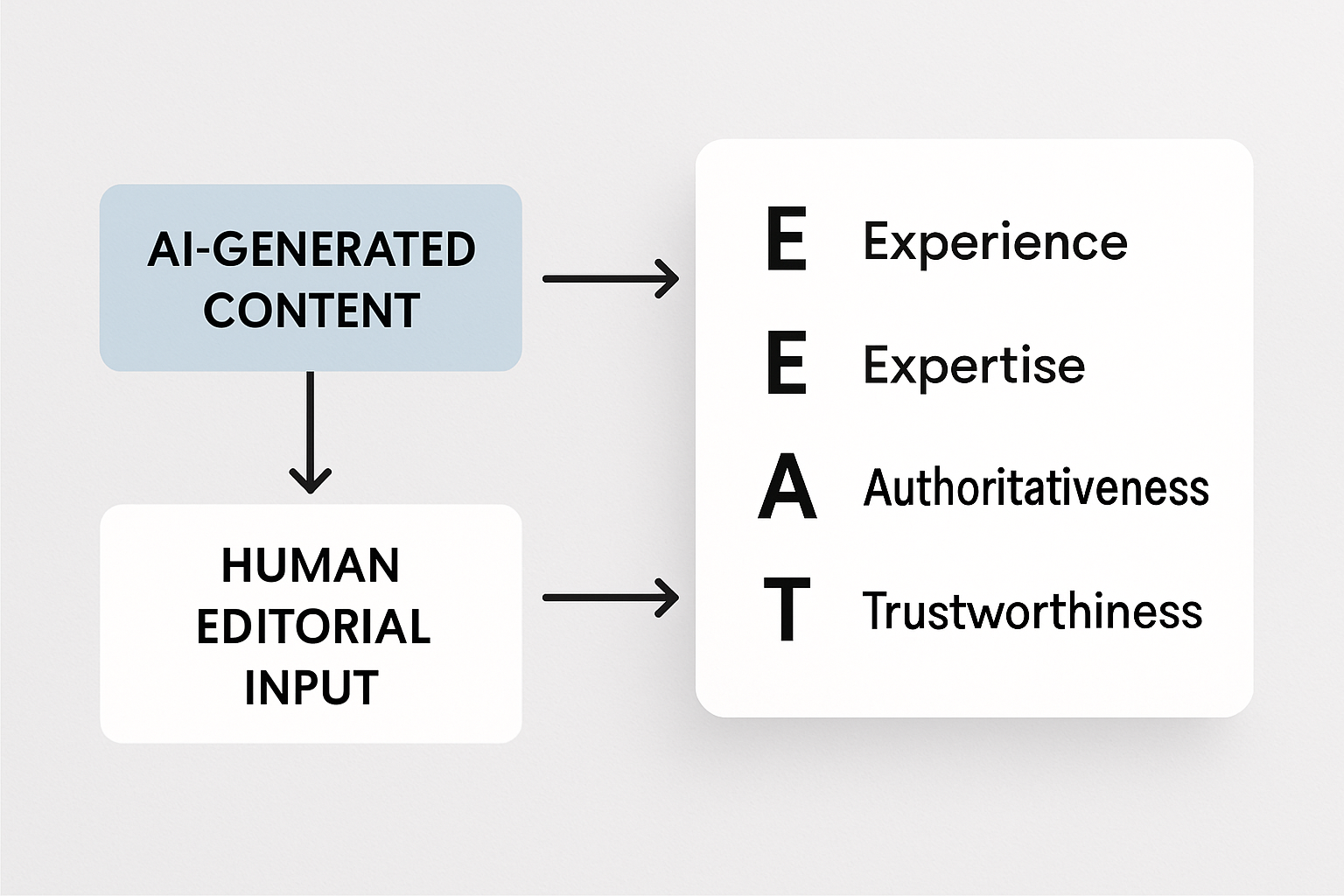
Google’s Helpful Content system rewards content that demonstrates Experience, Expertise, Authoritativeness, and Trustworthiness — commonly known as E-E-A-T. A well-configured SEO content generator supports these principles by ensuring structural quality, topical completeness, and factual alignment with high-authority sources.
However, the “experience” component is uniquely human. First-hand experience, original research, personal case studies, and unique professional insights cannot be generated by AI. This is why the smartest content strategies use AI for the structural and optimization layer while leaving the experiential depth to human contributors.
According to Google’s 2025 Search Quality Evaluator Guidelines update, content demonstrating real-world expertise receives significantly higher quality ratings than generic topical coverage. Pairing an SEO content generator with authentic human insight is the formula that consistently outperforms purely automated or purely manual approaches.
Why Should You Combine an SEO Content Generator with a Broader AI SEO Strategy?
An SEO content generator is one powerful piece of a larger AI-driven SEO strategy. Content generation alone does not address technical SEO issues, backlink building, local SEO, or site architecture optimization. The best results come from integrating content generation into a comprehensive approach that covers all organic search channels.
For a deeper understanding of how AI is reshaping every layer of search engine optimization, our detailed breakdown of AI SEO tools and how to use artificial intelligence to rank higher and grow organic traffic covers the full landscape of what’s now possible. Combining content generation with AI-driven technical auditing, link analysis, and rank tracking creates a compounding advantage over time.
Businesses that treat content generation as an isolated tactic often plateau quickly. Those that embed it within a full-funnel organic strategy — one where content, technical SEO, and off-page authority all reinforce each other — see sustainable, long-term ranking gains. That is the level at which AI truly transforms business results.
What Results Can You Realistically Expect from Using an SEO Content Generator?
Realistic expectations depend heavily on your niche, domain authority, and how well you implement the content. In a 2026 industry study, websites that adopted AI-assisted content workflows reported an average 47% increase in organic impressions within six months compared to their previous manual publishing pace. Results were strongest for sites publishing in informational and educational niches.
New websites in competitive industries should not expect overnight rankings regardless of the tool they use. Domain authority is built over time through consistent publishing, quality backlinks, and positive user engagement signals. An SEO content generator accelerates the content part of that equation — it does not shortcut the authority-building process.
The most realistic expectation is this: a good SEO content generator lets you do more of the right things, faster. It raises your publishing volume, improves your baseline optimization quality, and frees up strategic thinking time. Over six to twelve months, those compounding advantages translate into measurable organic growth for most businesses.
Frequently Asked Questions About SEO Content Generators
Frequently Asked Questions
What is an SEO content generator?
An SEO content generator is an AI-powered tool that creates search-engine-optimized written content based on your target keywords, topic analysis, and competitive SERP data. It automates the drafting, structuring, and optimization process to help websites rank faster and publish more consistently.
Is AI-generated content penalized by Google?
Google does not penalize content based on whether AI was involved in writing it. Google evaluates content on helpfulness, accuracy, and quality. AI-generated content that is reviewed, accurate, and genuinely useful to readers can rank just as well as manually written content.
How long should SEO content generated by AI be?
The ideal length depends on the keyword and the competitive landscape. Most informational articles that rank well range from 1,500 to 2,500 words, but your SEO content generator should guide you based on what the top-ranking pages for your specific keyword are currently publishing.
Can an SEO content generator replace a human writer?
An SEO content generator is best used as a powerful assistant, not a full replacement. AI handles structure, keyword optimization, and first drafts efficiently, but human writers add accuracy checks, brand voice, original insights, and the experiential depth that Google’s E-E-A-T guidelines prioritize.
How often should I update content created by an SEO content generator?
Content should be reviewed and refreshed at least every three to six months, especially for fast-moving topics. Search intent can shift, competitors can publish stronger content, and factual information can become outdated. Regular updates signal to Google that your content remains current and authoritative.
Do I need technical SEO knowledge to use an SEO content generator?
Most modern SEO content generators are designed to be accessible without deep technical SEO expertise. They guide you through keyword input, content scoring, and optimization suggestions in plain language. However, pairing the tool with foundational SEO knowledge will significantly improve your results.
Start Publishing Smarter with the Right SEO Content Generator
An SEO content generator is no longer a novelty — it is a competitive necessity for any business serious about organic growth. The combination of speed, consistency, and built-in optimization intelligence makes AI-powered content creation the most significant shift in SEO strategy since the rise of mobile search. Businesses that adopt these tools thoughtfully, with strong editorial oversight and a clear content strategy, will have a measurable advantage over those still producing content the slow way.
If you are ready to scale your content output without sacrificing quality, RankBloom SEO offers a smart, modern platform built specifically for businesses that want to rank faster and grow sustainably. RankBloom SEO combines AI-powered content generation with real-time optimization scoring, keyword intelligence, and actionable SEO guidance — all in one intuitive workspace designed for results, not complexity.
The gap between businesses ranking on page one and those buried on page five is increasingly a content volume and quality gap. An SEO content generator, used correctly, is how you close that gap — one well-optimized article at a time. Start building your content advantage today.