
The best SEO software for small business is a platform that combines keyword research, content optimization, technical auditing, and performance tracking — all in one affordable, easy-to-use interface. Small businesses rarely have dedicated SEO teams or large budgets, which means the tools they choose need to deliver maximum impact with minimal complexity. Choosing the right software can mean the difference between stagnating on page five of Google and consistently attracting new customers through organic search.

Studies show that 68% of all online experiences begin with a search engine, yet fewer than 1% of users click past the first page of results. This statistic alone explains why SEO is no longer optional for small businesses competing in digital spaces. Without the right tools to guide your strategy, you are essentially invisible to potential customers searching for exactly what you offer.
If you are new to the topic and want to understand the foundation first, reading about what SEO is and how it drives organic traffic to your website will give you the context you need before diving into software selection.
What Is SEO Software and Why Does Every Small Business Need It?
SEO software is defined as a digital tool or platform that helps businesses improve their visibility on search engines by analyzing keywords, auditing websites, tracking rankings, and optimizing content. Without software, managing SEO manually would require hours of spreadsheet work, guesswork, and constant checking of dozens of metrics. The right platform automates these tasks and surfaces the insights that actually move the needle.
Small businesses face a unique challenge: they are competing against larger brands with bigger teams and budgets. SEO software levels the playing field by giving small business owners access to the same data and intelligence that enterprise marketers rely on. A good tool helps you identify which keywords your target customers are searching for, how your website performs technically, and which content improvements will generate the fastest results.
According to BrightEdge research, organic search drives 53% of all website traffic across industries — more than any other channel, including paid advertising. That means investing in SEO software is one of the highest-return decisions a small business can make. The compounding nature of organic search means that improvements made today continue to pay dividends for months or years.
What Features Should You Look for in SEO Software for Small Business?
The best SEO software for small business must include keyword research, on-page optimization guidance, site health auditing, rank tracking, and competitor analysis at a minimum. Beyond those core features, modern platforms are now integrating artificial intelligence to generate content briefs, suggest internal linking opportunities, and predict which optimizations will have the greatest impact. These AI-powered capabilities are no longer a luxury — they are quickly becoming the standard.
Keyword Research and Search Intent Analysis
Keyword research is defined as the process of identifying the specific words and phrases your target audience uses when searching for products, services, or information related to your business. Effective keyword research goes beyond search volume — it requires understanding search intent, which is the reason behind a user’s query. Tools that surface intent data help you create content that directly satisfies what searchers are looking for, which is a primary factor in Google’s ranking algorithm.
Look for tools that categorize keywords by intent — informational, navigational, commercial, and transactional. This classification helps you match the right type of content to each stage of the buyer journey. A small business selling handmade candles, for example, needs different content to rank for “what are soy candles” versus “buy soy candles online.”
On-Page Optimization and Content Scoring
On-page optimization is defined as the process of improving individual web pages so that they rank higher in search results and attract more relevant traffic. Good SEO software provides real-time scoring and recommendations as you write or edit content — covering keyword placement, readability, heading structure, meta tags, and internal linking. This guidance removes the guesswork and helps even non-technical business owners publish well-optimized pages consistently.
AI-powered content tools have transformed on-page optimization by analyzing top-ranking pages and identifying exactly what your content needs to compete. To understand how these tools work in practice, explore how AI-powered SEO content generators help you rank faster and publish more. These solutions dramatically reduce the time between content idea and published, optimized post.
Technical SEO Auditing
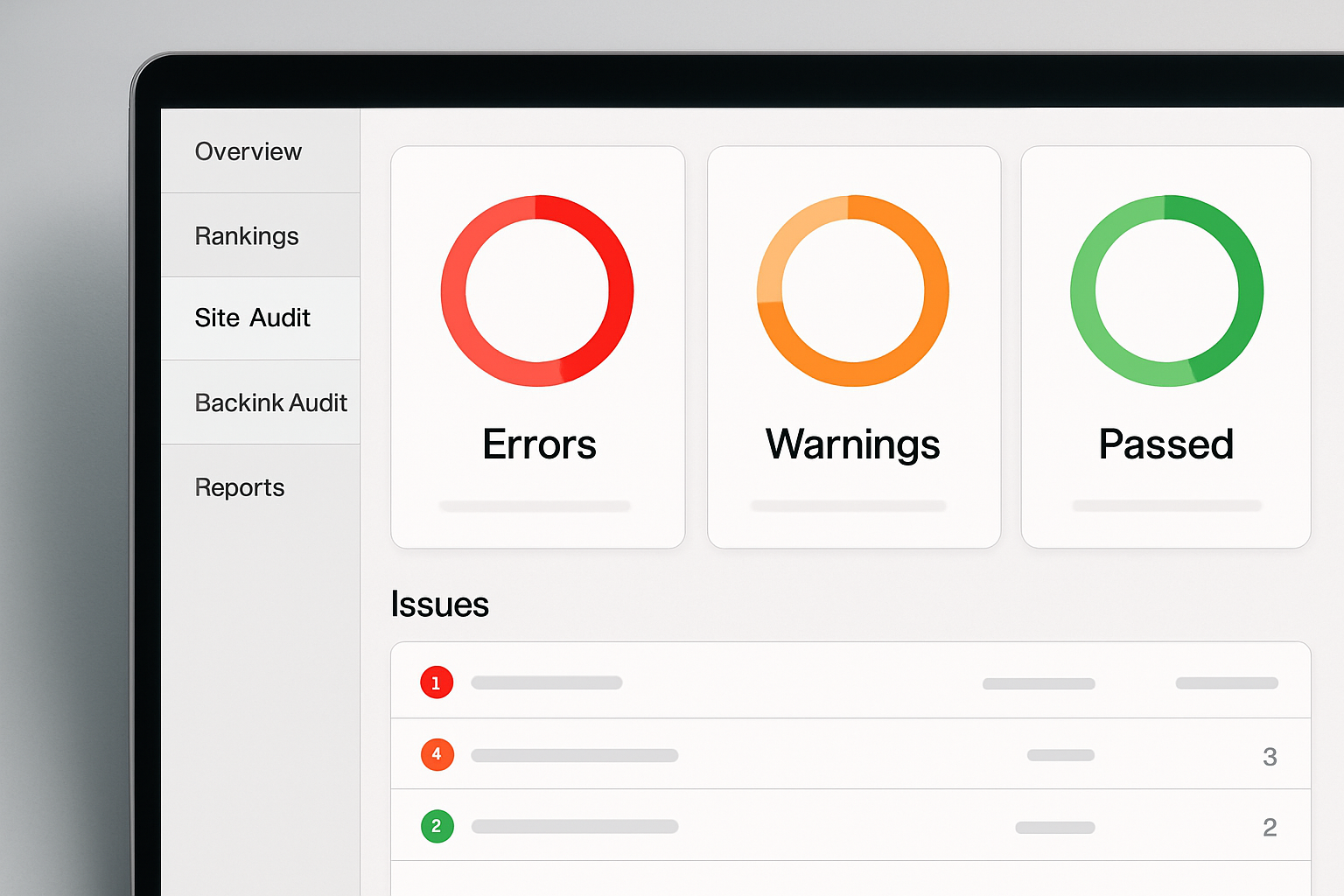
Technical SEO refers to the backend improvements that make a website easier for search engine crawlers to access, interpret, and index correctly. A solid SEO audit tool will scan your site for broken links, slow loading pages, missing meta descriptions, duplicate content, crawl errors, and mobile usability issues. Fixing these problems is often the fastest way to recover lost rankings or unlock traffic that is already within reach.
Many small business owners overlook technical SEO entirely because it feels intimidating. However, modern SEO software simplifies this by presenting audit results in plain language with prioritized action lists. You do not need to be a developer to understand that a page is loading too slowly or that your XML sitemap has errors.
Rank Tracking and Performance Reporting
Rank tracking allows you to monitor exactly where your web pages appear in search results for your target keywords over time. Without tracking, you have no way of knowing whether your SEO efforts are working or whether algorithm updates have impacted your visibility. Good SEO software provides daily or weekly rank updates, historical trend charts, and location-based tracking for businesses serving specific geographic areas.
Performance reporting should be simple enough for a small business owner to interpret without a data analyst. Look for dashboards that summarize organic traffic trends, top-performing pages, keyword movement, and conversion data in visual formats. The goal is to spend less time interpreting data and more time acting on it.
How Does AI Change the SEO Software Landscape for Small Businesses?
Artificial intelligence has fundamentally changed what SEO software can do, particularly for small businesses that lack large teams. AI tools can now generate full content briefs, identify semantic keyword clusters, automate internal linking suggestions, predict ranking opportunities, and flag content gaps faster than any human analyst. This means a solo entrepreneur or small marketing team can execute an SEO strategy that previously required an entire agency.
Studies indicate that businesses using AI-assisted SEO tools publish content 3x faster while maintaining higher quality scores than those relying on manual processes alone. Speed and consistency are critical in SEO — the more high-quality content you can publish regularly, the broader your keyword footprint becomes. AI makes that volume achievable for businesses of any size.
For a deeper understanding of how artificial intelligence integrates with modern search optimization, the guide on AI SEO tools and how they help you rank higher and grow organic traffic is an excellent resource. It walks through specific applications of AI in keyword research, content creation, and technical optimization that are directly relevant to small business owners.
Why Choose Modern AI-Powered SEO Tools Over Traditional Platforms?
Traditional SEO tools were built for agencies and enterprise teams — they are complex, expensive, and require significant training to use effectively. Many legacy platforms charge hundreds of dollars per month for features that small businesses will never use, while burying the most actionable insights under layers of menus and reports. Modern AI-powered platforms are designed to surface insights instantly and translate them into clear action steps.
The core difference between traditional and modern SEO software comes down to accessibility and speed. Legacy platforms present raw data and leave interpretation to the user, while AI-driven tools analyze that data and tell you exactly what to do next. For a small business owner managing multiple responsibilities, that difference in usability is transformational.
Modern platforms also integrate across the full content lifecycle — from idea generation and keyword research, to content creation, optimization, publishing, and performance monitoring. This end-to-end integration eliminates the need for multiple disconnected tools, which reduces costs and simplifies workflows significantly.
What Are the Most Important Benefits of SEO Software for Small Business Owners?
- Time savings: Automated audits, rank tracking, and content scoring free up hours every week that would otherwise go to manual research.
- Cost efficiency: One well-chosen SEO platform replaces the need for multiple standalone tools, reducing overall software spend.
- Competitive intelligence: Understanding which keywords competitors rank for helps you identify gaps and opportunities in your content strategy.
- Consistent content quality: On-page scoring and AI suggestions ensure every page you publish meets current SEO standards.
- Scalable growth: Good SEO software grows with your business, allowing you to expand your keyword targeting and content output over time.
- Measurable ROI: Clear performance dashboards connect your SEO activity directly to traffic and revenue outcomes.
- Local SEO support: Small businesses serving local areas benefit from tools that optimize for location-based search terms and Google Business Profile performance.
How Should Small Businesses Approach Their SEO Strategy Using Software?
The best way to use SEO software as a small business is to follow a structured, repeatable process rather than making random optimizations. Start with a full technical audit to identify and fix any critical issues holding your site back. Then conduct thorough keyword research to build a content roadmap based on what your target customers are actually searching for.
- Run a technical audit: Identify and resolve crawl errors, broken links, slow pages, and mobile issues before creating new content.
- Define your target keywords: Focus on a mix of high-intent keywords with achievable competition levels for your domain authority.
- Create an optimized content plan: Use your SEO software to build a content calendar that targets different keyword clusters systematically.
- Optimize existing pages: Improving pages that already receive some traffic is often faster than building ranking authority for brand new pages.
- Track and iterate: Monitor keyword rankings weekly and adjust your strategy based on what is working and where you are losing ground.
For those just getting started, a practical set of SEO tips for beginners on how to start ranking your website on Google provides a solid foundation before you dive into more advanced software features. Building good habits early means your SEO efforts compound much faster over time.
How Do You Evaluate Whether SEO Software Is Worth the Investment?
Evaluating SEO software comes down to three core questions: Does it save you meaningful time? Does it provide actionable insights you can act on without expert knowledge? And does it contribute measurably to your organic traffic growth? If the answer to all three is yes, the investment is justified for most small businesses.
Consider the cost of not investing — small businesses that neglect SEO rely entirely on paid advertising, referrals, or social media traffic, all of which are unpredictable and expensive. Organic search traffic, built through consistent SEO effort supported by strong software, is one of the most reliable and cost-effective long-term growth channels available.
Look for platforms that offer transparent pricing, free trials, and responsive customer support. A tool that is too complex to use consistently will never deliver results, no matter how powerful its feature set. Ease of use is not a compromise — it is a requirement for small business SEO tools.

What Makes RankBloom SEO the Right Choice for Small Businesses?
RankBloom SEO is an AI-powered platform built specifically with small business owners in mind — combining keyword research, content optimization, technical auditing, and performance tracking in one clean, affordable interface. Unlike traditional legacy platforms that require significant training and large budgets, RankBloom SEO is designed to deliver actionable insights immediately, regardless of your technical background. It removes the complexity that has historically made professional-grade SEO inaccessible to smaller teams.
The platform’s AI capabilities make it particularly valuable for small businesses that need to compete with larger brands on a fraction of the budget. From intelligent content scoring to automated rank tracking and semantic keyword suggestions, RankBloom SEO does the heavy analytical lifting so that you can focus on growing your business. It is a modern solution built for the realities that small business owners face in today’s competitive search landscape.
—
Frequently Asked Questions
What is the best SEO software for small business owners on a tight budget?
The best SEO software for small businesses on a budget is one that combines essential features — keyword research, on-page optimization, rank tracking, and site auditing — in an affordable, easy-to-use package. AI-powered platforms like RankBloom SEO are designed specifically for this need, delivering professional-grade insights without the enterprise price tag.
How long does it take to see results from SEO software?
Most small businesses begin to see measurable improvements in rankings and organic traffic within 3 to 6 months of consistent SEO work supported by good software. Technical fixes and on-page optimizations can show results faster, sometimes within 4 to 8 weeks, while new content typically takes longer to build authority.
Can I do SEO myself with software, or do I need to hire an agency?
Modern AI-powered SEO software is specifically designed to empower non-experts to manage their own SEO effectively without needing to hire an agency. Platforms that provide clear recommendations, content scoring, and step-by-step guidance make it possible for a small business owner to execute a competitive SEO strategy independently.
Is AI-powered SEO software better than traditional SEO tools for small businesses?
Yes, AI-powered SEO software is generally better suited to small businesses because it translates complex data into simple, actionable recommendations without requiring deep technical knowledge. Traditional legacy tools were built for agency teams and require significant expertise and time investment to use effectively.
What is the most important SEO feature for a small business just starting out?
The most important feature for a small business new to SEO is keyword research combined with on-page optimization guidance, because these two capabilities directly impact whether your content gets found by the right people. Starting with solid keyword targeting and optimizing each page you publish ensures that every piece of content contributes to your rankings from day one.
—
Start Growing Your Organic Traffic Today
Choosing the right SEO software is one of the most impactful decisions a small business can make in today’s digital landscape. The tools you invest in determine how efficiently you can research keywords, create optimized content, fix technical issues, and track your progress toward real business growth. With the right platform, even a team of one can build a powerful, sustainable organic presence that attracts customers consistently — without relying on expensive paid advertising.
If you are ready to put proven strategies into practice, exploring proven SEO strategies that drive real results for website ranking will give you a clear action plan to pair with your software investment. And if you want to fully harness the power of AI in your content process, learning how to use AI to write SEO articles for your business and rank on Google will accelerate your results significantly.
RankBloom SEO is the smart, modern choice for small businesses ready to take their organic growth seriously. Try RankBloom SEO today and discover how AI-powered tools can transform your search visibility, save you time, and deliver the kind of measurable results that make a real difference to your bottom line.